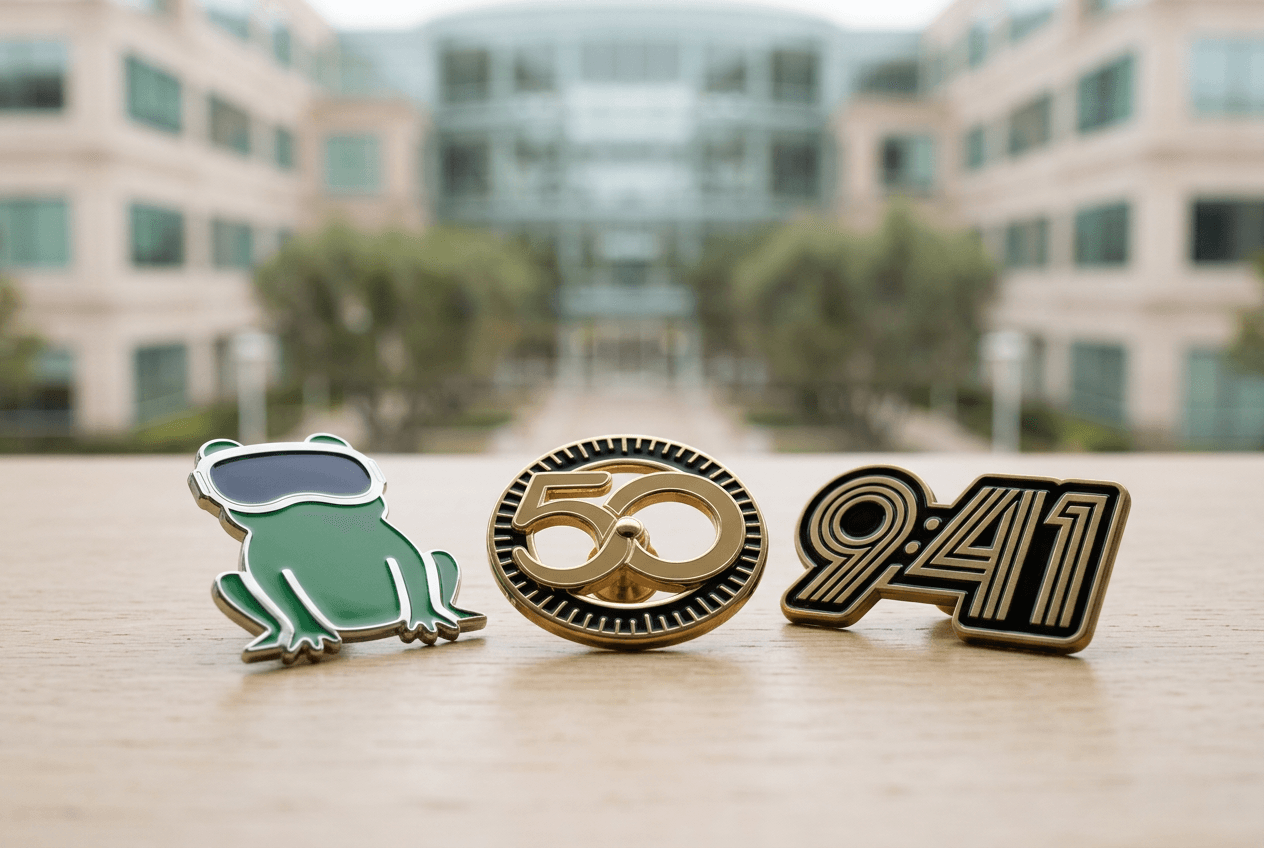
The 50th anniversary pin is the most ambitious object I've ever designed. A mechanical history, a manufacturing history, and a slightly more intimate one: what Apple did to me, and what this small metal object tried to give back.
I need to tell you about this particular pin, because I haven't been able to get it out of my head since the sample landed at my place. In the previous article about the 2026 collection, I only brushed against it — I told you it was the piece of the edition that mattered most to me, that it was the most ambitious object I'd designed so far, and then I moved on because there were eight other pins to present and that loop deserved its own lap. So here we are. Sit down, let me tell you about the 50th anniversary pin.

Fifty notches, 8 pins, and three editions in
Why I'm still making WWDC pins in 2026
The gesture, one more time
For those who didn't read the previous article and are landing here cold, let me set the scene quickly.
You're holding a restrained black circle in your hand, about four centimeters across — one and a half inches in American measurements, roughly the size of a large coin you really feel in your palm. Around its edge, fifty small notches evenly spaced. At the center, two numerals: a five and a zero. The whole thing feels like a piece of watchmaking stripped down to the bone. You could stop there, find it elegant, set it on your shelf.
Except if you brush it with your fingertip, the central 50 pivots. It turns. The outer circle stays fixed, anchored to the back metal; the central element is free.
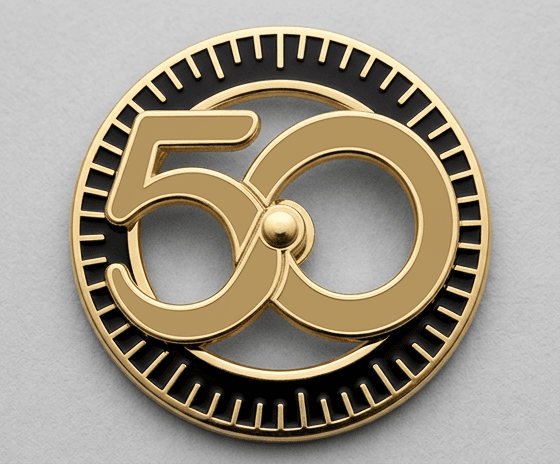
And in that mechanical duality — that tiny mobility at the heart of an otherwise immutable object — sits everything I wanted to say with this thing.
Where the idea came from
The spinner idea didn't fall on me in some grand designer epiphany. It came from frustration, actually. I spent part of my winter 2025 holiday sketching ideas for the 2026 collection, and every time I got to the 50th anniversary pin, I hit the same wall. An apple with "50" engraved into it: too obvious, already done, boring.
The outline of Apple Park in relief: pretty, but purely decorative. A worked-up type treatment in commemorative-medal format: everyone has done that for everyone, from Volkswagen to the Rotary Club — except, fuck, we're young, we don't yet have the white hair of Rotary grandees (Martin, yours is starting, sorry), and this pin had to fit in the pocket of a hoodie-wearing guy queueing at 6 a.m. outside Moscone, not in the display case of a service club. With every attempt, I felt like I was commemorating something rather than celebrating it. And commemorating Apple is precisely what one should never do — it's a company that, against every law of organizational dynamics, refuses to become a museum of itself.
The spinner idea came one morning while I was absent-mindedly turning the crown of my Apple Watch as I waited for my coffee to brew. The ordinary gesture sent me somewhere else. The Digital Crown, that small ring that turns without visibly actuating anything mechanical, is one of Apple's great gestures. A gesture that says I keep moving forward even when the object itself doesn't move. And there, in the half-light of the kitchen, it clicked: what if the pin itself had its own little engine? What if commemoration weren't frozen but in motion? What if we turned Apple instead of fixing it in place?
An hour later, I had the first sketch in Notability on my iPad Pro. Fixed outer circle, free central element, geometry that holds together. The next two hours were spent turning the sketch into something defensible — in other words, finding why the two parts, fixed and mobile, had to mean something together, and not just be a mechanical gimmick.

App Store
Notability: AI Note Journal
Ginger Labs
Laden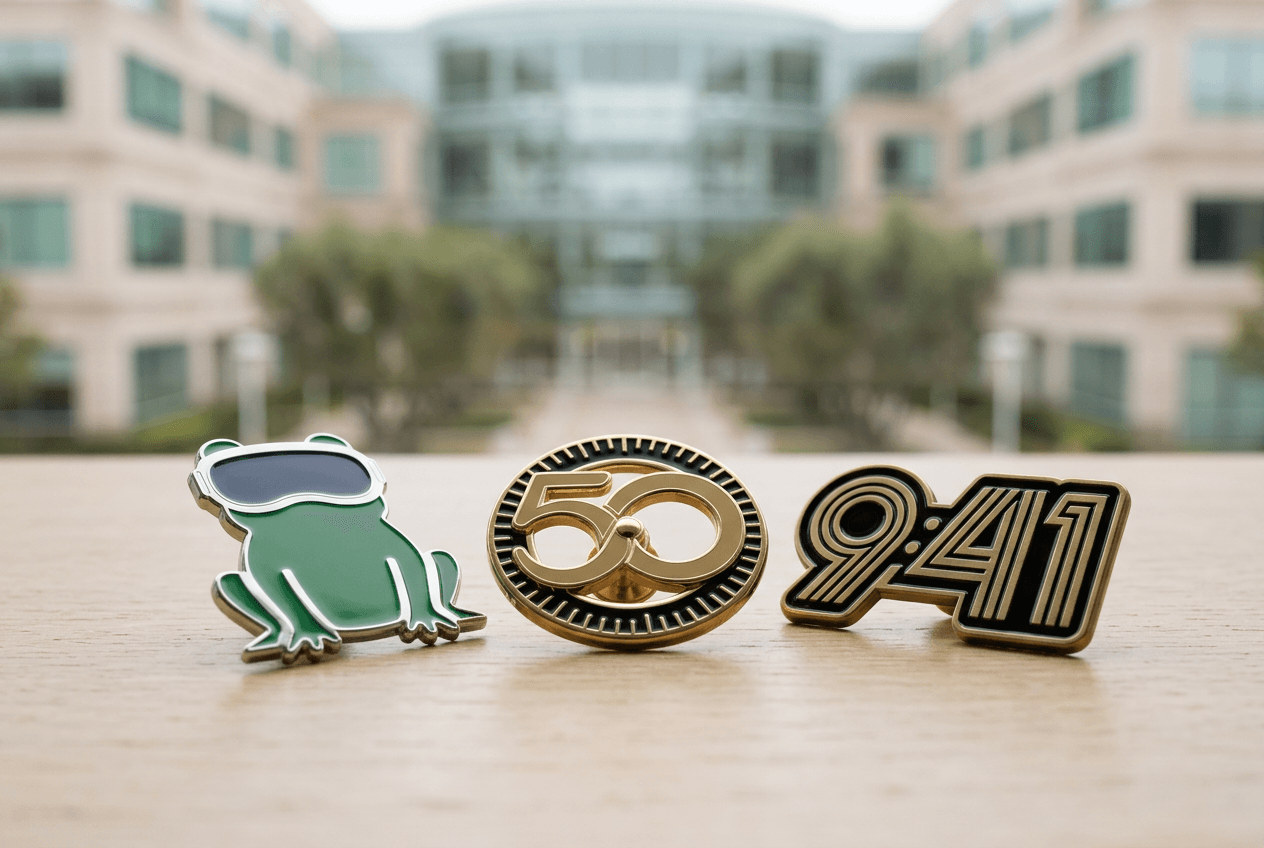
Why fifty notches
That's when the fifty notches appeared. Obvious: fifty notches for fifty years, we're in the right order of magnitude. But that wasn't enough. A dial with fifty notches, any pin workshop can produce one while watching TV. The notches had to have a reason to be there, precisely there.
Apple Park, seen from above, is a ring. You know this if you've ever typed "Apple Park" into Maps, or if you've been lucky enough to walk along its facade between Tantau Avenue and the Visitor Center. It's a continuous curved ribbon, with no beginning and no end, closing the enclosure back on itself. Foster + Partners didn't design a building; they designed an architectural promise: we don't stop, we continue, it's a path, not a destination. When I realized that my fifty notches could be read as facade modules seen from very high altitude, the object started to stand on its own. The outer ring was no longer just "a notched dial"; it was Apple Park in satellite view, reduced to its essential gesture.
And that ring is fixed on the pin for a precise reason. It's the foundation. The structure that doesn't move. Fifty years that Apple has existed, fifty years that it has stood despite moments when almost no one would have bet on its survival — think of 1996, the NeXT acquisition, Jobs returning, the moment when Michael Dell publicly suggested shutting the company down and returning the money to shareholders. When you watch an eighteen-year-old student today unbox his first MacBook Neo, something hasn't moved since the Apple I came out of a Los Altos garage in 1976. That ring is that permanence. The structure that resisted everything — including itself.
A small detail I'll leave as a riddle: those fifty notches are not all identical. A few, scattered around the ring, are slightly larger than the others — because in my eyes, some years mattered more than others in Apple's history, and the dial discreetly carries their trace. Can you spot which ones, and guess why I chose those rather than others? I won't give the answer here. If you ever hold the pin in your hand, look closely — and send me your list. We'll talk about it over a beer in Cupertino, in Paris, or at a DubdubDinner.
The center that turns, and the why of the lemniscate
And then there's the central element, which turns. There, I could have stopped at a simple "50" in San Francisco type, made it pivot, and called it done. Everyone would have found it cute. No one would have asked a question.
But I wanted the number itself to be the symbol.
If you look carefully at the 5 and the 0 I drew, you'll notice that they are not placed side by side like two glyphs aligned in a word. The curves of the two numerals meet and extend into one another. The overall line forms a lemniscate. The mathematical symbol for infinity. The "∞" you draw without ever lifting the pen, and that you can keep drawing indefinitely if you have the patience.
This is not a cheap pun, nor is it typographic affectation. Until it moved in April 2017, Apple's headquarters were at 1 Infinite Loop. The infinite loop. A postal address as manifesto. It's one of the very rare cases in recent history where a company chose its address so that it would say something about its philosophy, rather than enduring whatever address city planners had assigned it. Infinite Loop, in computer science, is technically a bug — a loop that never exits — but metaphorically it's also that engine that never shuts off. Apple named itself after its most fully embraced flaw: never stopping.
And when the company moved in 2017, it didn't betray that promise; it reformulated it in stone. The Foster + Partners ring takes up exactly the same idea: a path that returns to its origin, a building without end, a geometry that says there will always be an after. I wanted this pin to encapsulate that double motion. The foundation that doesn't move, and the engine that turns. The home and the momentum. Yesterday's 1 Infinite Loop and today's Apple Park, condensed into four centimeters of cast metal.
A slightly more intimate note about 1 Infinite Loop
Allow me a necessary detour. I'm not old enough to have known 1 Infinite Loop during the great Jobs years.
I was born in 1991, so when the campus officially opened in 1993 I was only just starting to care about screens.
But I went there, and often: 2009, 2011, 2012, 2013, 2014, and roughly every WWDC after that as long as it was still the right place.
For many people in my generation of Apple developers, it was almost a ritual passage.
The place in question was not an Apple Store. It was the Apple Company Store, opened in 1993 at the same time as the campus, and it was a strange beast in the Apple ecosystem.
No XXL glass facade, no blond-wood tables overloaded with iPads, no Genius Bar. A modest door on the ground floor of one of the headquarters buildings, and behind that door a shop no other place in the world could match: it was the only place on the planet where you could buy Apple-branded merch — t-shirts, mugs, pens, absurd things, made without shame, almost all proudly "made in China", that West Coast employees wore with pride because they knew what they meant. A shop-for-the-people-by-the-people atmosphere, not a marketing showroom.
The first visit, then, was in 2009. I was a student arriving at my first WWDC, invited — I already couldn't believe I had a badge, especially since at the time WWDC cost $1,499 and mine had been gifted to me. My English was about as convincing as a Spanish Basque: understandable if you listened closely, rich in gestures, but not exactly easy.
I remember pushing that door open while telling myself I was entering somewhere I wasn't really supposed to be, and walking out half an hour later with four t-shirts, three mugs, eight pens, a student bank account in tatters, and the impression that I had touched the carpet of a building where decisions had been made that ended up changing my profession. For anyone who missed the point: moderation was not the mood of the moment.
In the years that followed, I became more reasonable when it came time to pay — but the ritual of stopping by never disappeared. Every WWDC, I made the detour, bought something, and left with a slightly different goodie each time.
Then Apple renovated the Company Store in 2015. The shop was transformed into an almost-standard Apple Store, a few months before Apple Park officially opened in April 2017. And that's when the Company Store spirit went out — much more than with the final closure on January 20, 2024, which was only the closing of a small Apple Store that had become ordinary.
The absurd, proudly "made in China" goodies disappeared. The Apple Park Visitor Center took over the merch role, but differently: ambitious Foster + Partners architecture, staging, cafeteria, a bird's-eye view of the campus as a giant model. It's beautiful, chiselled, designed. And that's precisely why it isn't the same thing anymore. The original Company Store had a modesty, a roughness, a sense of "corporate back office accidentally made public" that we won't get back.
When I drew the 50th anniversary pin, I had that little pinch in mind. Not a sad tribute — Apple doesn't like pathos — but a wink. The center that turns is the infinite loop that never really closed, even when one of its founding places was turned into a standardized Apple Store.
The mold, the mold, and the mold again
Right, back down to earth. Once the concept was clear, it had to be manufactured. And that's where many ambitious pins die.
What costs money when you make pins, let me repeat because it's counterintuitive: it's neither the metal, nor the enamel, nor the labor. It's the mold. Every new geometry requires dedicated tooling at the factory, and a rotating mechanism like this one requires not one but two molds — which have to fit together with a tolerance measured in millimeters. Too tight: it grinds or jams. Too loose: it floats, dangles, and eventually gets torn off by the first coat sleeve. The acceptable zone between the two is narrow, and no one at the factory knows in advance where it lies for a given design — you have to prototype.
I went back and forth with the factory three times. The first sample turned, but with too much play: you could hear a little "tac" when you rotated it, like a cheap watch. Unacceptable. The second turned too stiffly: you had to press with your thumb to make it move. Not the smooth, discreet gesture I wanted. The third, finally, was the one. When it arrived in its FedEx envelope and I turned the 50 with the tip of my thumb in the kitchen, I smiled to myself like an idiot (even if I am an eternal idiot). Quiet. Satisfying. Slightly addictive. The kind of gesture you repeat without thinking while you're on the phone.
And yes, I spent a serious amount of money on it. I signed quotes I had to read twice. For an object offered as an add-on to the campaign — and that I could have produced as a "simple 50, non-spinning" version for a quarter of the price — it's a decision that makes no economic sense. Unless you accept that this is not about economics. It's about an object trying to live up to what it commemorates. Apple spent fifty years spending money it didn't have to make things no one thought they needed. The least we owe it, when making an anniversary pin for it, is not to do the opposite.
Apple in 1976, Apple in 2026
One last thing, and I'll leave you alone. When you design an anniversary object, you're forced to ask what exactly you're commemorating. Fifty years of Apple is a phrase, but what do you put behind it?
Apple in 1976 is two guys in a Los Altos garage hand-assembling motherboards sold to electronics enthusiasts who wanted to tinker with their own computer. Apple in 2026 is a company worth more than three trillion dollars in market capitalization, designing its own chips etched in Taiwanese foundries, shipping its OS on devices people wear on their wrist, place on their nose, or almost implant in their pocket every morning without thinking about it. Between the two, there is a distance that should be impossible for a company to cross. And yet.
The trap, when telling this story, is to read it as a straight line, like a success story written in advance. But nothing was written. There are at least three moments in Apple's history when the company should have collapsed and didn't — the desert crossing from 1985 to 1996, the near-bankruptcy of 1997, and even the 2010s, when more than one analyst was betting on a "Nokia-style" decline that never came. What interests me in these 50 years is not the triumph; it's the stubbornness. The ability, time after time, to refuse the ending.
And that's exactly what the pin tries to say. The outer circle, fixed, is continuity of intent — making tools people love using, formulated one way or another from Wozniak to today. The center that turns is the capacity for reinvention. Not foundation against movement, but foundation that enables movement. A company whose stability is not rest; it's a condition for moving forward.
If I had to summarize in one sentence what this pin tried to capture, that would be it.
To close
The 50th anniversary pin is currently in full-scale production. The first units will reach backers in a few weeks. If you added it to your order as an add-on, it will be in your package. For those who missed the campaign, keep an eye on 2027 — there will probably be sequels, add-ons, new nonsense.
In the meantime, I'll be in San Francisco and then Cupertino in June for WWDC — assuming my Golden Ticket eventually arrives. As I write this, I still haven't received mine, but I'm waiting patiently; it'll come through eventually. I'll lead the WWDC Run early one morning, host the fifth edition of the French-speaking dinner around a much-too-long table, run an AI evening, and between all that hand-deliver pins to those who made the trip. If you want to join us for one of these moments, the hub is dubdub.community — that's where I centralize everything. And if you want to hear Baptiste explain his 9:41 obsession in detail, the episode is coming soon on the Command+P podcast.
More directly, this 50th anniversary pin is also the kind of object that sums up pretty well how I approach my consulting projects. Disproportionate attention to details that are only visible when you remove them. An obsession with the fluid gesture where the easy path would be to ship the rigid one. A determination that the final object live up to the original intent, even when that means three back-and-forths with the factory instead of one. If that's the kind of rigor you're looking for on a project — app, product consulting, or strategic positioning in the Apple ecosystem — let's talk. I don't pretend to be any less obsessive on a mission than I am on a four-centimeter pin.
Fifty spinning notches. A lemniscate that doesn't stop. An infinite loop that keeps looping.
See you very soon, in Cupertino.