The letters are already here.
Your tray holds exactly what the grid needs. Nothing to invent; a little arrangement to discover.
 Tilzl iPhone · iPad
A little logic. A lot of letters.
Arrange the tiles, connect the words, and enjoy the moment it all comes together. A word and logic game for iPhone and iPad.
Coming to the App Store
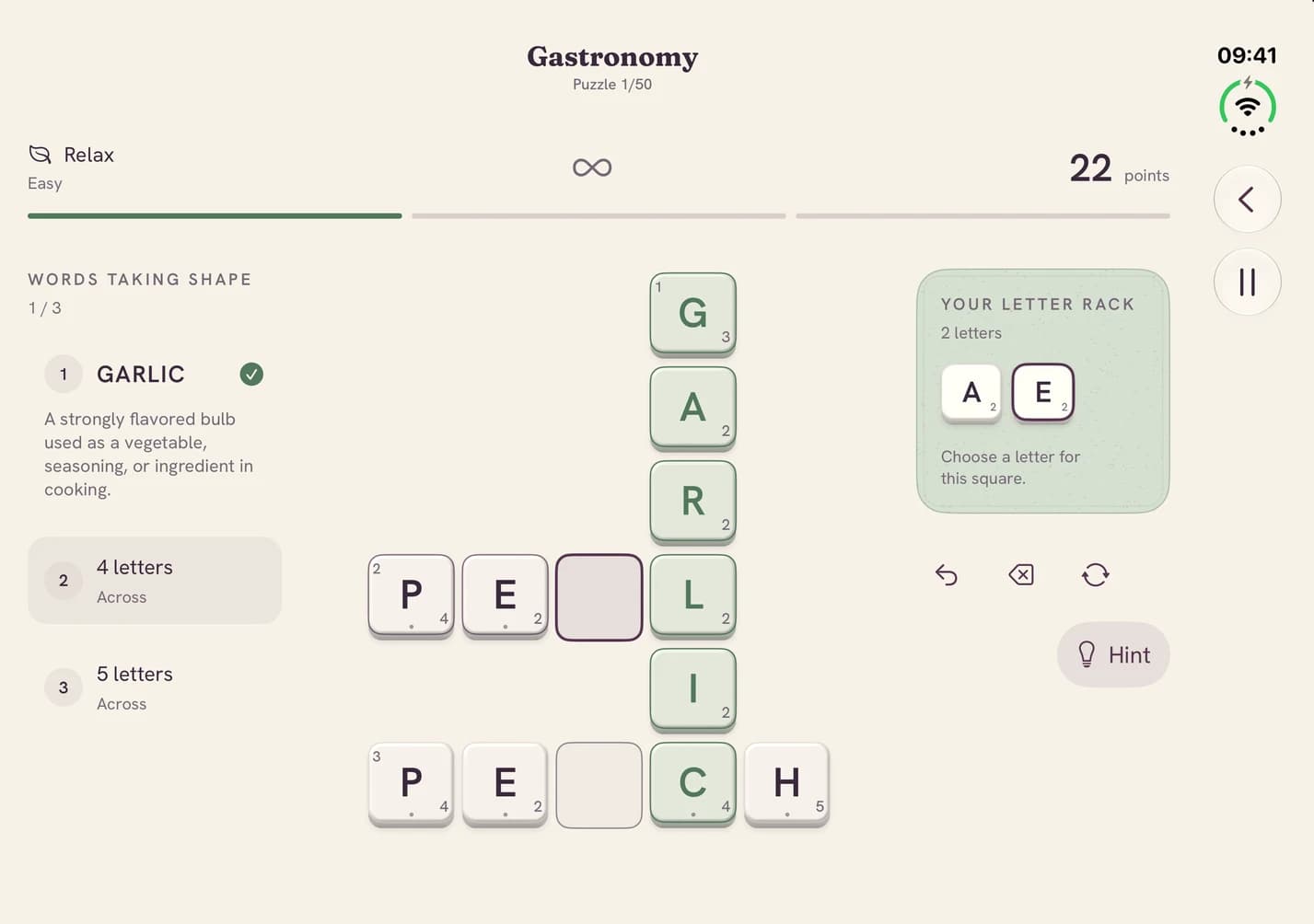
Choose a space, then a tile. You can also drag a tile, or type its letter.
Adapted from the Gastronomy collection, with extra letters already in place.
A small move. A new possibility.
Your tray holds exactly what the grid needs. Nothing to invent; a little arrangement to discover.
A letter can belong to two words. Place one, look again, and another possibility appears.
Return a tile to the tray, change your mind, or ask for a hint. There is room to explore.
A closer look
The same pleasure of playing, from the palm of your hand to the big screen.
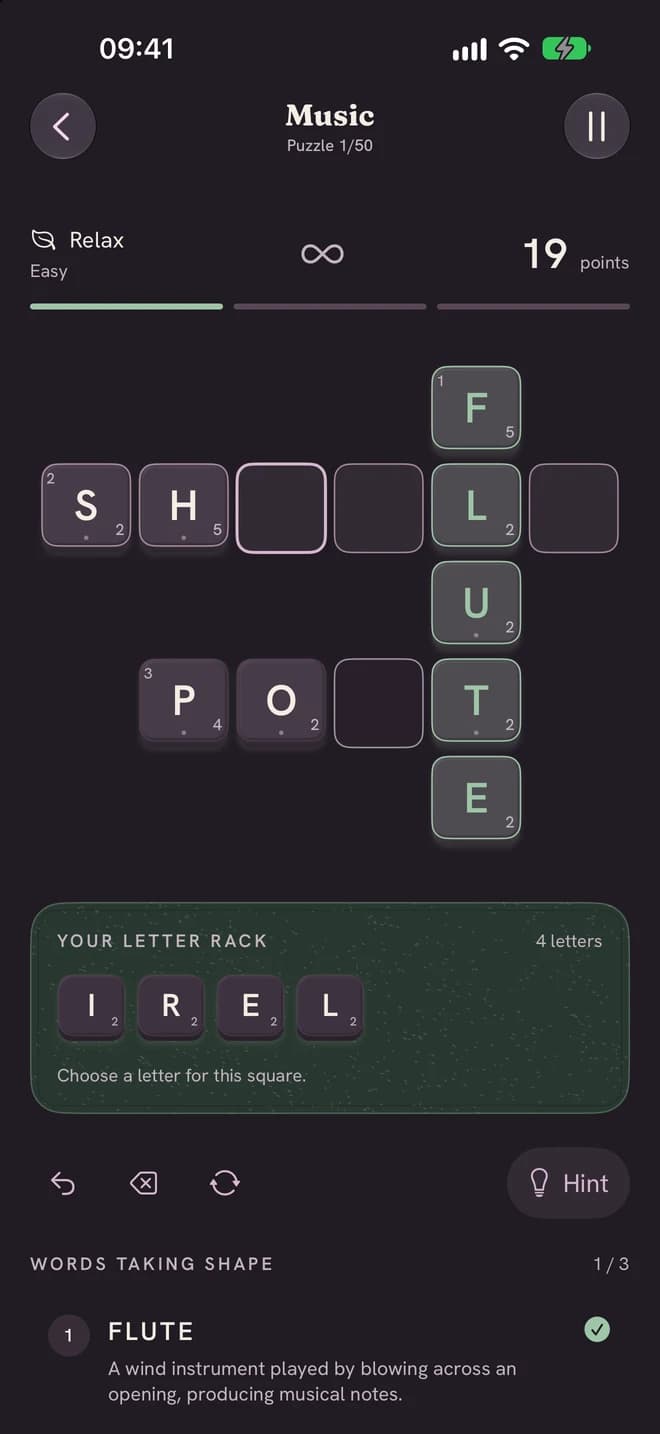
iPhoneA quiet moment in dark mode
DuoRoom for every letter
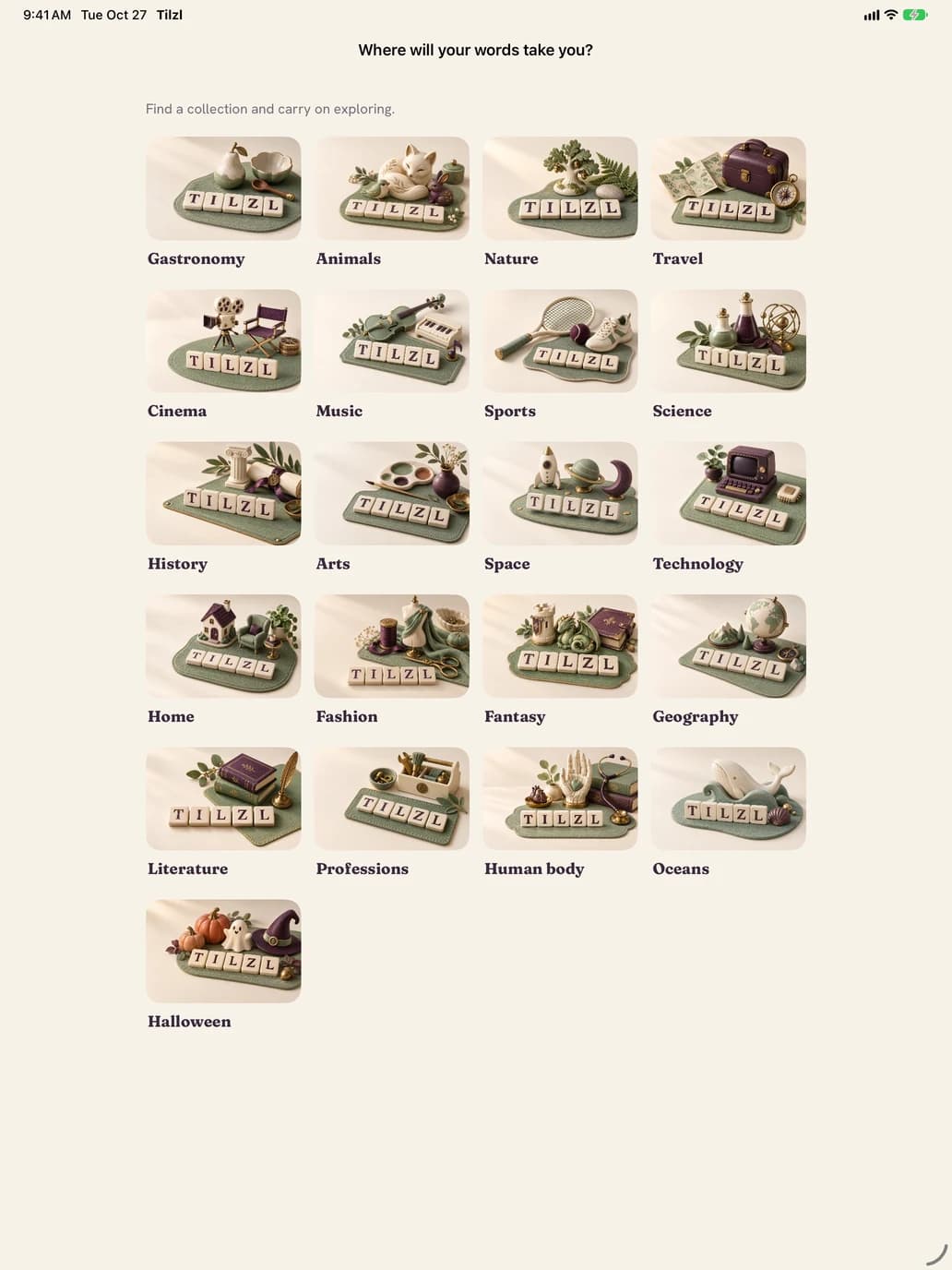
iPadA world of collections
The pleasure of figuring it out
There is something satisfying about seeing a possibility become a word. These studies offer a way to look at that experience.
Ross & Vallée-Tourangeau · 2019
In a word-production task with seven physical tiles, Ross and Vallée-Tourangeau found only a marginal overall benefit of interactivity. Detailed analyses linked manipulation time to performance; verbal fluency also mattered. This is an exploration of a particular task, not proof that moving tiles improves cognition.
In Tilzl: make an idea visible by placing a tile, then reconsider it.
Read the studyDanek & Wiley · 2017
Danek and Wiley asked 70 people to explain 37 magic tricks. Pleasure, suddenness and certainty were central to their “aha” experiences. Incorrect answers could also feel like insights. The study concerns magic tricks, not Tilzl.
Our design reading: let the completed word remain visible, with a brief celebration.
Read the studySimons et al. · 2016
Ryan, Rigby & Przybylski · 2006
Across four studies, Ryan and colleagues linked perceived autonomy and competence to enjoyment of video games. Their multiplayer survey also linked connection with others to enjoyment. These findings do not establish an effect of Tilzl’s modes.
In Tilzl: choose your pace, your difficulty, and whether to play together.
Read the studyMake yourself comfortable
Take your time. No countdown, just you and the letters.
Find your rhythm, then try to beat your own time.
A countdown, a grid, and the pleasure of a little pressure.
Share one device or meet online with Game Center. Cooperate in Relay, compete for points in Mosaic, or divide the letters in Doubles.
Solo puzzles and same-device play work offline. Online games require an internet connection and Game Center.
A different world of words
20 year-round collections and 8 seasonal collections, with 50 puzzles each. Seasonal collections open on their scheduled dates.
Three daily puzzles, one per difficulty, with an archive of past days.
Inside the making
I wanted placing a letter to feel like a small, deliberate gesture. The details follow that idea.
Imagined and developed by Clément SauvageIvory ceramic tiles, a sage felt tray and a plum ink. Movement and optional haptics give picking up and placing a tile a distinct feel.
Fraunces and Hanken Grotesk, adjustable text, dark mode and an optional OpenDyslexic font. The app adapts its layout to iPhone and iPad.
The bundled grids are checked by a solver for a unique solution against the game’s dictionary. This verifies the puzzle; it does not guarantee that every definition is flawless.
Coming to the App Store
iPhone · iPad · iOS 26