
The French Apple community needs no one to exist — it's everywhere, scattered, unkillable. What it lacked was a central anchor. ⌘+F is that beacon, and the three of us are carrying it.
There's a moment I know by heart. The talk wraps up, the speaker closes their MacBook, and that's exactly when it gets interesting. On the sidewalk, in the café across the street that's pulling down the shutters in twenty minutes, in the message thread that opens up that same evening. Someone finally admits they've been stuck on something for three weeks. Two people who'd never met decide to work together. A junior realizes they're not the only one fumbling. Then everyone heads home, and all of it dissolves. We start over at the next occasion, as if memory simply didn't carry forward — as if SwiftData, or CoreData for the veterans, had only ever been smoke and mirrors.
⌘+F is my way of stopping that waste. Not one more conference in an already saturated calendar. A rallying point that comes back. A light in the night, a corner bistro where we chat, swap notes, pit our apps and our ideas against each other, fight for them, help each other out and — why not — grow fond of each other. So that what forms in those margins stops evaporating.
The name is already the whole manifesto
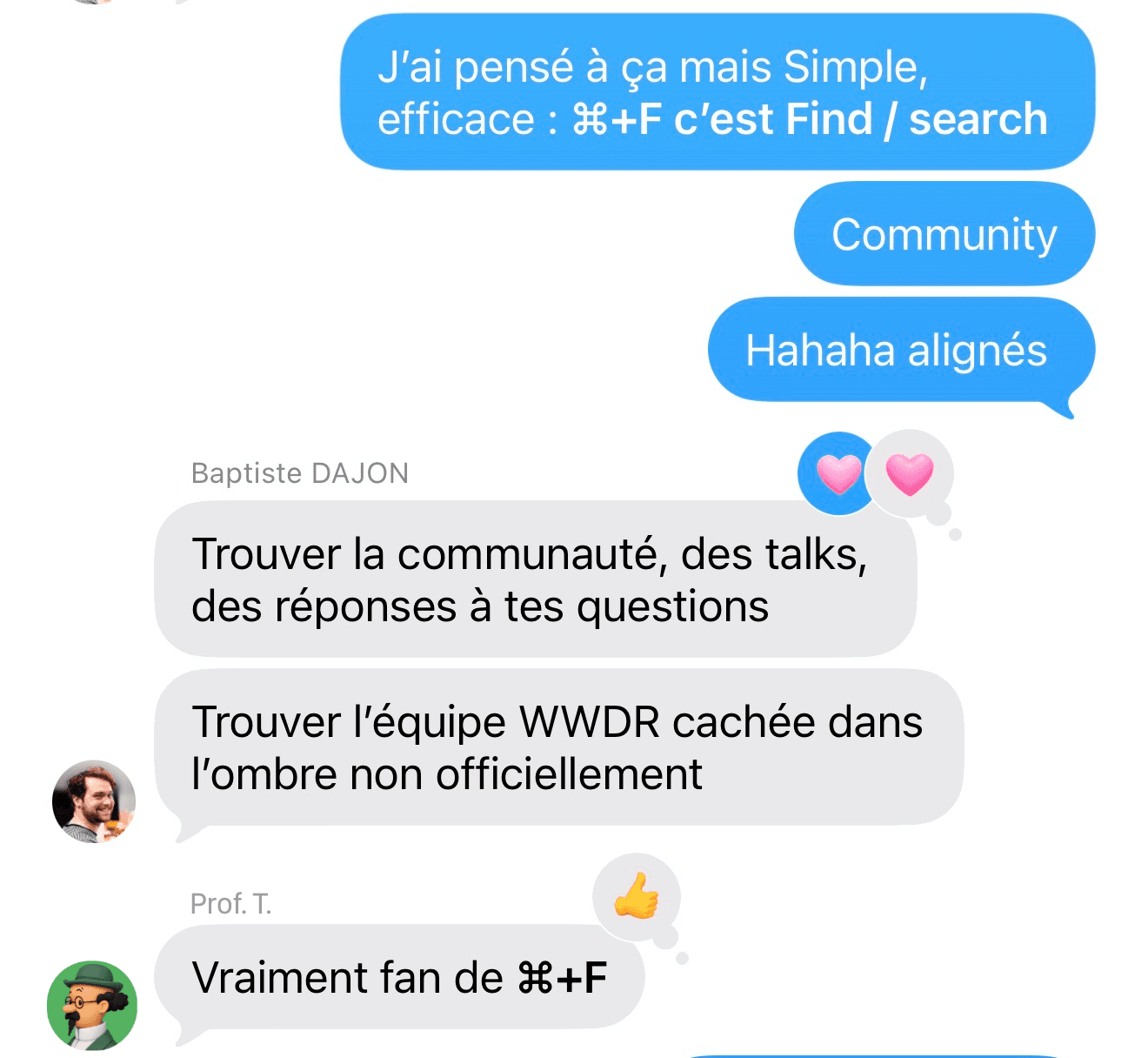
We didn't pick ⌘+F to be clever. Honestly, we didn't really pick it at all: it surfaced one night, well past midnight, in an iMessage group — among OGs, among die-hards of the brand, we weren't about to brainstorm anywhere else — where we'd been circling the project without finding how to name it. Florent, Baptiste, me, and Professor Tournesol — someone who throws himself into this community harder than anyone and who, for his own reasons, prefers to stay in the shadows; we respect him enough not to drag him out of them. I finally dropped these two characters, after a string of suggestions funnier than they were serious and frankly borderline — Les Lascars du Build (LLDB), or Codeurs Libres Apple, Natifs & Geeks (CLANG), inside jokes on our own toolchain. ⌘+F, though, was unanimous on the spot. And suddenly everything fit. Because that name tells, all on its own, exactly what we want to do — provided you know how to read it. And that's the catch: everyone in the ecosystem presses this key a hundred times a day, and almost no one knows what it is.
The ⌘ first. That little four-looped knot was drawn by Susan Kare — the designer behind the entire iconography of the first Macintosh: the trash can, the cursor, the fonts. She went looking for it in a Scandinavian road sign: the Sevärdhet, the symbol that, in Sweden, Norway, Finland and Iceland, marks a point of interest — a place worth stopping for.
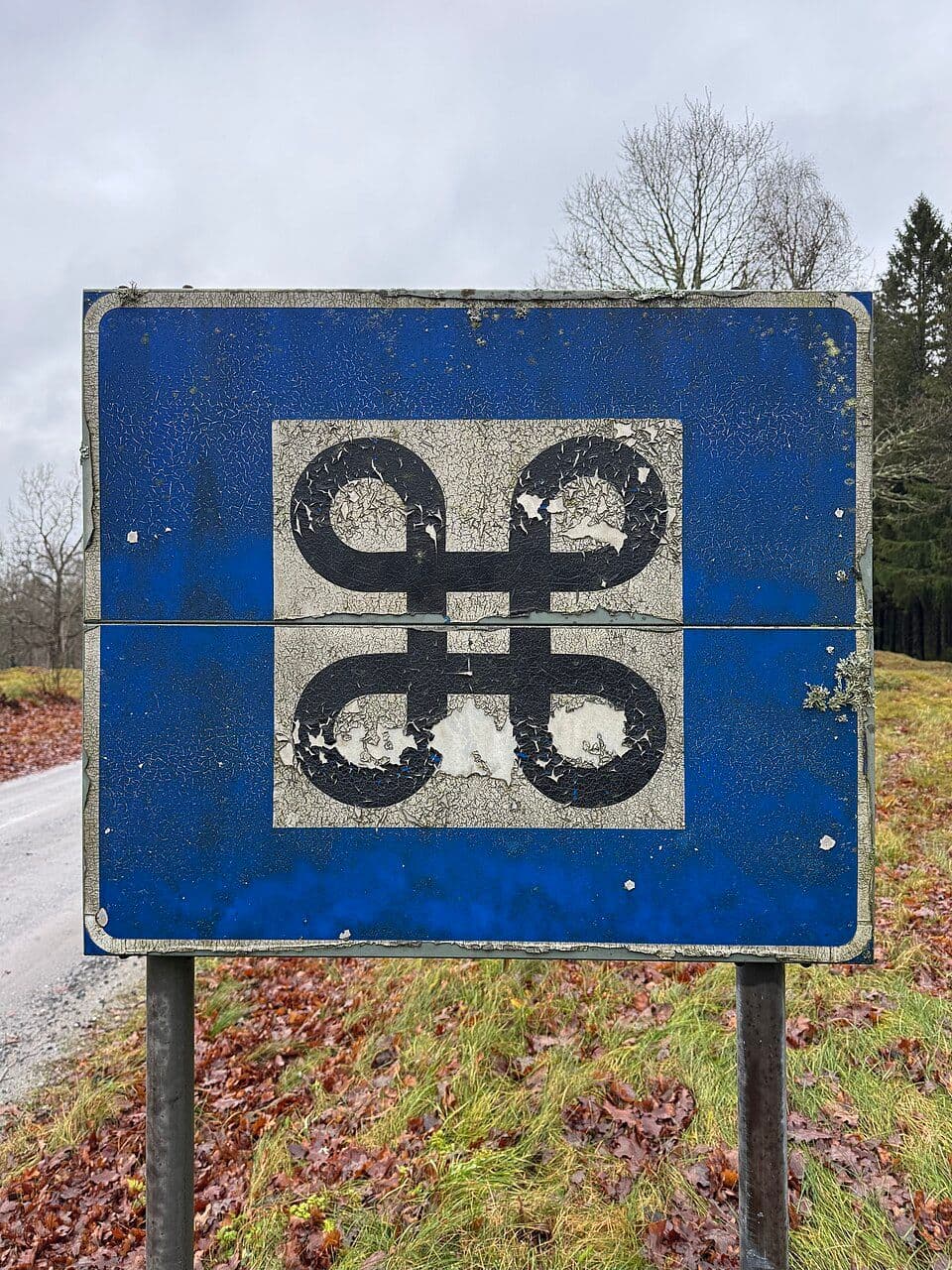
Hard to dream up a better motto for a project whose whole purpose is to create places where people stop. And there's an irony I'm especially fond of: this glyph replaced the Apple key on our keyboards in 2007 — the exact year I wrote my first line for Apple. The symbol left such a mark that many people still say "Apple-C" — Pomme-C in French — to copy, years after the icon disappeared. So much so that the French singer Calogero named a 2007 album Pomme C. A sign can outlive what it stood for. That's precisely the kind of memory we want to keep alive.
The F next. Officially, it's the shortcut to search — Find. But we deliberately leave the field open: Friends, Family, Fierce, Francophones, Froggies. The letter is a container, not a label. Where most shortcuts serve to close or to quit, ⌘+F serves to find — to open. It's the one gesture on the whole keyboard that says "look, there's bound to be something here." The project lives in that paradox: a name everyone knows through their fingers and almost no one knows how to read. Exactly like this community — present everywhere, rarely named.
This community isn't waiting to be invented
Let's be honest about the starting point: there's nothing to found. Francophone Apple developers are already here, and they're solid. They move through studios, large corporations, solo apps shipped on weekends, schools, private channels where people help each other out at ungodly hours, conversations that spill far beyond the room where they began. Many have gone the distance since the original iPhone — they ran meetups, mentored hackathons, built teams and kept writing Swift when loving Apple wasn't quite in fashion in the rest of tech.
Talent isn't what's missing. Neither is appetite. What's missing is regularity — a gathering that doesn't depend on a keynote to exist, that doesn't light up once a year only to fade right away. A heartbeat, not fireworks.
And the voice is missing too. Because this community's one real flaw is that it's silent — paradoxical, for the French. That silence has a cost: invisible from Cupertino, invisible from the European institutions, at the very moment when Brussels and Strasbourg are rewriting the rules that decide what we're allowed to code, to distribute, to monetize. I may be the only fool who's gone to the European Commission and Parliament a dozen times this year to carry a developer's voice there. And I go with a stated conviction: I defend a certain idea of the Apple platform, of the coherence and the security it guarantees, against the grain of much of the prevailing discourse. You're free to disagree with me — plenty in the community do, and that's healthy. But the point isn't who's right. It's that with no one in the room, it's the void that speaks in our place. ⌘+F is not a lobby; it's the opposite — a place for this community to stop being inaudible, to think, to argue it out, and to eventually figure out what it has to say.

And I want to state right away what, to me, separates this project from yet another circle: ⌘+F is not a club. The risk with any gathering of capable people is sliding into a chapel — citing one another, reciting the latest releases like a sales pitch, mistaking seniority for a license to judge. I want exactly the opposite. A place where you explain what you've finally understood, where you say without embarrassment what you don't yet master, where you actually wrestle with new tech instead of parroting its pitch, and where you leave with something you can open in Xcode on Monday morning.
Fifteen years in the field, and that can't be faked
I've been building on Apple platforms since 2007. First app published almost the moment the App Store opened, invited as a student to WWDC in 2009 and then attending on my own dime since 2011 — I've written about that elsewhere — I lived through the era when tickets sold out in two hours, then five minutes, then seventy-two seconds, before the lottery, before today's format. Around forty apps behind me, hundreds of millions of cumulative downloads, teams trained at Orange, LVMH, Airbus. I don't lay this out as a trophy cabinet, but because you don't grant yourself the right to build a company, a movement, a collective like this without first wearing down your soles, dragging your boots through the mud, eating dirt and taking the hits. A community isn't proclaimed with a logo and a sign-up form: it's earned over time, in the meetups kept alive when the topic wasn't a crowd-pleaser, in the same beginner questions heard a hundred times without a sigh, in those shy faces met one evening who today are the references you consult. That presence — indifferent to the media weather — is the only capital that counts.
I've spent years lighting sparks that, frankly, were never quite as one-off as they sound. The Francophone dinners I've kept going ever since the last dinosaur set down his bags for a well-earned rest in Madagascar — Michel, if you're reading this, we love you, and do go take a look at his association. The AI evening, not nearly as impromptu as it looked, put together with some exceptional companies as sponsors so the community's devs could discover tools beyond their own. The "WhatsApp Frenchy @ dubdub" I've run for three years, a living agora all year round and not just keynote week. The WWDC Fr Slack I've kept since 2014, picked up after Didier, of Mac4Ever, wound down his mailing list. It always took. And every time I left with the same nagging question: why does it always have to start from square one? ⌘+F is the decision to stop starting from zero. But to understand where that obsession comes from, you have to go back further than my own beginnings.
Three ages of one flame
Before the meetups, before Slack, before all of it, there were the Apple User Groups. An era many have forgotten, when the Apple community was structured by Apple itself: local clubs, an official program launched in the mid-80s, an actual house insignia you'd pin proudly to the wall. That's where, at the very start of my career, I set foot in this world — in one of those groups near Lille, InterMac. A detail that still moves me a little: the association still exists, and the old "Apple User Group" badge is still on its site. Except it survived by half-pivoting toward photography. The relic held on, but by changing its skin so as not to disappear. There's the whole problem condensed into a single association: these places don't die all at once, they fade slowly for lack of someone to keep them going.
Then came my CocoaHeads years. I ran the Lille chapter for years, and I hold real affection for it. It was the right formula: devs in a room, a topic, beers, and conversations worth the trip. But let's be clear — it's running out of steam too. Not for lack of love, but from wear on the model itself. In Paris, the people holding the reins aren't developers at all anymore — or they swear by nothing but AI (which I love, don't judge me), or they do a bit of Swift, a bit of Flutter, a bit of React Native. Yes, yes, I dabble too, I just don't advertise it — and as Georges Brassens sings in À l'ombre des maris, "let the one who has never sinned cast the first stone." Me, I'm prudently standing behind them.
And that's where something quietly breaks: you can run flawless logistics, but you can't animate a technical community from outside the technical. It ends up showing in the room. I say this without contempt, precisely because I was there: it's the observation of someone who held the mic, not the comment of a guy sitting in the back. And let's be clear, because the question will come up: no, ⌘+F is not becoming my main job. I'm still an entrepreneur, a consultant and a business angel — that's my profession and I'm not dropping it. ⌘+F is a side project, but the kind that makes me tick, the kind you take on because you can't help it.
And then there's a deeper shift, almost tender. CocoaHeads. Cocoa. That's the framework that made our hearts beat for years — the foundation of everything we built. But in the age of Swift, SwiftUI and agentic coding, who really knows anymore what Cocoa is? Better still: how many devs who came in over the last five years could say where the NS that still prefixes NSString or NSArray comes from? (NeXTSTEP. The operating system of NeXT, the company Jobs set up in 1985 after being ousted from Apple, and that Apple eventually bought back in 1997 — bringing Jobs along with it. Forty years after its birth, its DNA still runs through our APIs every day.) The NS is to code what the ⌘ is to the keyboard: a sign we type without seeing it anymore. This isn't trivia. It's the symptom of a gap: the platform's memory no longer transmits itself on its own. The veterans carry it without putting it into words; the newcomers code on top of it without knowing it. And between the two, there aren't many places left to build the bridge.
There are the three ages I've lived through: the Apple-backed AUG, the meetup carried at arm's length, and today a platform where we generate Swift without always knowing what we're generating. With each transition, we gained power and lost a little memory. ⌘+F is my attempt at a fourth age — a movement where the NS becomes a story we tell each other rather than a prefix we endure, where the bridge between generations isn't left to the chance of a post-talk café. Not to make juniors recite Apple's history, but because a dev who understands why their stack looks the way it does codes better than one who swallows it as a black box.
Why a three headed hydra — and why does ours have those two more?
I could have run this alone. It's even my reflex, the entrepreneur who loads everything onto his own back. But a community held up by a single person isn't a community: it's an audience. And an audience consumes — it transmits nothing. The proverb puts it better than I can: alone you go faster, together you go further. And it's the stars we're reaching for with ⌘+F.
So there are three of us. And I didn't go shopping for two complementary profiles on a skills spreadsheet. Florent Morin and Baptiste Dajon are friends. The kind you don't only see at conferences, the kind you lean on when something goes sideways. Above all, the kind capable of looking me in the eye and saying "stop, you're screwing this up, you're going to burn out" — no sugar-coating. That, I believe, is the most serious qualification you can demand of a cofounder. You don't build a collective founded on honesty with people who flatter you. The honesty starts among the three of us, or it doesn't hold.
I take on the CEO title because a company needs one, full stop. But not for a second do I forget that I have two exceptional cofounders beside me, people I'm close to, and that I'm honored — in the full sense of the word — that they chose to be here.
Florent is rigor without the noise. He often breaks ground on visionOS, Swift, SwiftUI before others, but he'll never sell you an update as a revolution — he publishes his raw findings for the community to use, and he goes after the topics that genuinely move people forward rather than the ones that make headlines. When I get carried away, he's typically the one who brings me back to reality.
Baptiste lives at the seam of two worlds we set against each other too often. On the big-company side, he's the link between product teams and the Apple platform; on the indie side, he's been developing since the iPhone 3G and even saw one of his visionOS projects picked up by Apple. He refuses to choose a camp, and that's exactly the tension ⌘+F has to inhabit — because the French scene is neither just heroic indies nor just faceless big structures; it's the tense, fertile dialogue between the two.
Between the three of us we cover different geographies — while Lille remains the city closest to my heart, I spend a lot of time in Paris and London — different relationships to the platform, and one shared obsession: putting the project ahead of our own little showcases. We won't pretend otherwise: we'd love for this to grow, and why not, for it to be noticed all the way to Cupertino. But the ambition serves the project, not the other way around. And the iMessage group where it all started counts a fourth accomplice: Prof. T., who does an enormous amount but prefers, for his part, to stay off-camera. Every community that lasts has its craftsman in the shadows.
And around us, there are those who keep coming back — not founders, but presences we count on where it actually happens: on stage, in workshops, in the conversations afterward. Claire Sivadier, for instance, a Swift developer you'll often run into at Francophone gatherings, as solid on the technical side as on the teaching — and simply the kind of person you want to work with. A community is known by its regulars as much as by those who signed at the bottom of the page.
Four ways to come together
We ruled out deploying everything at once. Each format serves a clear function — writing code, grasping a concept, meeting people, passing the baton — and we keep only what genuinely moves the needle.
The meetups set the cadence: a topic that's actually useful, questions asked without detours, and time afterward to hang around and talk. Paris, the larger provincial cities, the rest of the Francophone world, or remote when the subject deserves to go beyond the walls of a room.
The highlights are the rarer occasions — around Vision Pro, Apple Silicon, Foundation Models, or simply a dinner — designed to leave a shared trace. The kind of evening you're still talking about two years later because something got tied together there.
The onboarding, schools and companies strand is transmission in the strict sense. For students: getting into Swift, SwiftUI and Apple's design logic without drowning in jargon. For companies: tailored work calibrated to the team's real level, not a generic course recited over their heads.
The thread running through all of it: teaching without lecturing, sparking interest without overselling, keeping the door open to students, to career-changers, to teams that want to level up, and to everyone who still has the urge to do things well. Demanding and welcoming at the same time — remove one and you break the other.
We'll talk dates when they can stand on their own
The only promise I can make honestly today: no fixed dates yet. And that's deliberate.
We're locking the first topics, the first venues, the first speakers — and finalizing the first three gatherings, which are going to be huge. I'd rather announce little but solid: a precise subject, a real place, people who've genuinely done what they're coming to talk about. Not a date tossed out to hold ground. We'll communicate when it's tenable, because a canceled gathering is a broken promise, and a community is built on the exact opposite.
The first dates aren't far off. If you want to be notified at the right moment, signing up for the letter at cmdf.io is, for now, the only thing to do — nothing else, just the dates that matter. And for the rest, let's follow each other on X and LinkedIn.
Who speaks, where, on what: all of that will follow. But the core is settled. There's finally a fixed point for this community I've been lighting in fits and starts for fifteen years. This time, we're not letting it fade.
A quick aside as I write these lines: I've just received my WWDC invitation. See you in Cupertino in June.
And as one of my mentors and friends, Jeff Lawson, the founder of Twilio, would say: Onward.
— Clément
PS — The nod to Brassens goes to my father, who passed a little over ten years ago, and to whom I owe everything I know about French song. I never got to take him to San Francisco — he would have loved to see, with his own eyes, the blue house from Maxime Le Forestier's "San Francisco," still standing on its hill.