

Case study · Ottie
Built for procrastinators.
A little otter for procrastinators, with ADHD in mind. Small actions and a fully native Apple experience to help you start and stay on track. Ottie is by your side.
- Client
- Ottie
- Scope
- iPhone & iPhone Duo · Local & cloud AI · Siri AI · App Intents · In-app purchases · MVP · Independent product
- Clément
- Clément SauvageProduct Engineer & Technical Lead
- Role
- Independent product · Product design · iOS development
- Technology
- Swift · SwiftUI · AI
Product gallery
The product in pictures
Interfaces, applications and physical objects in one narrative.
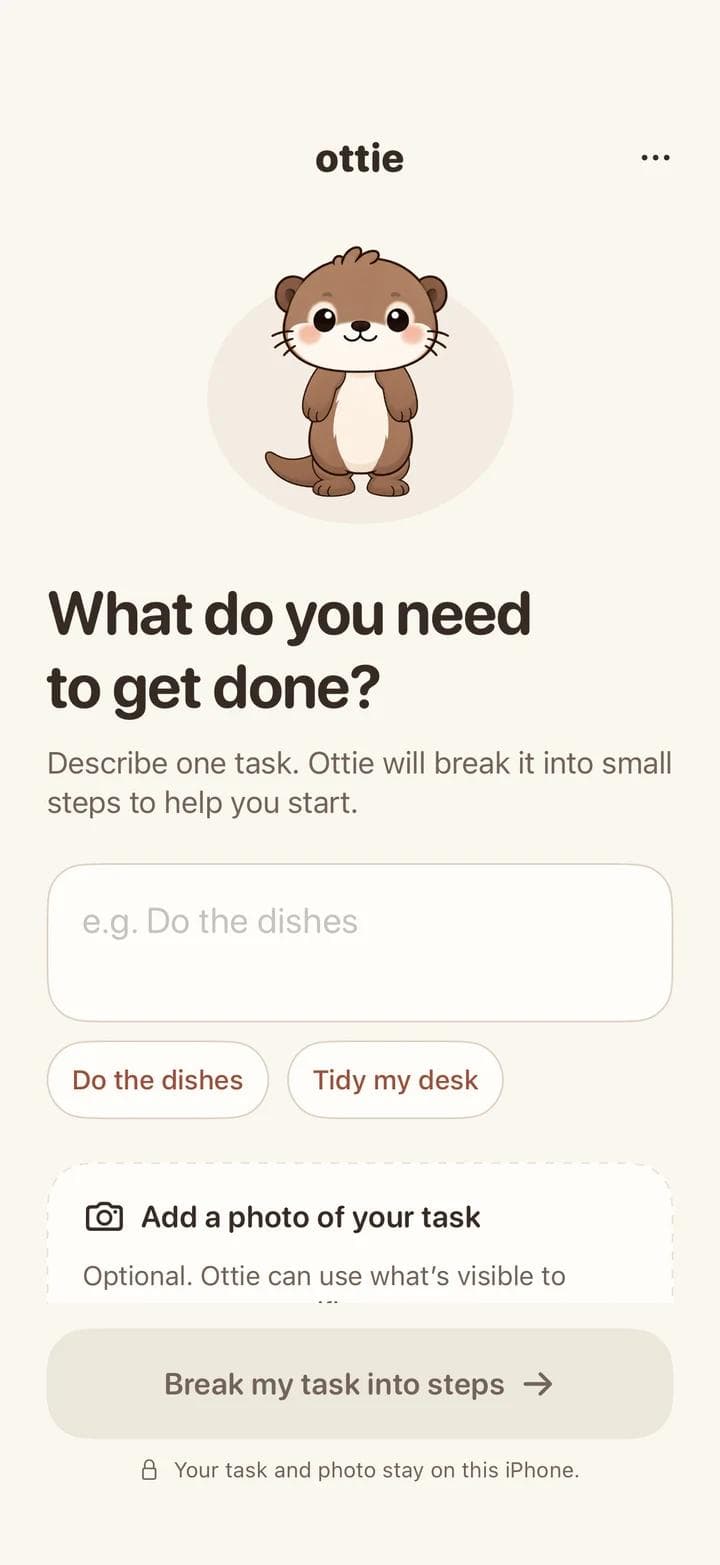
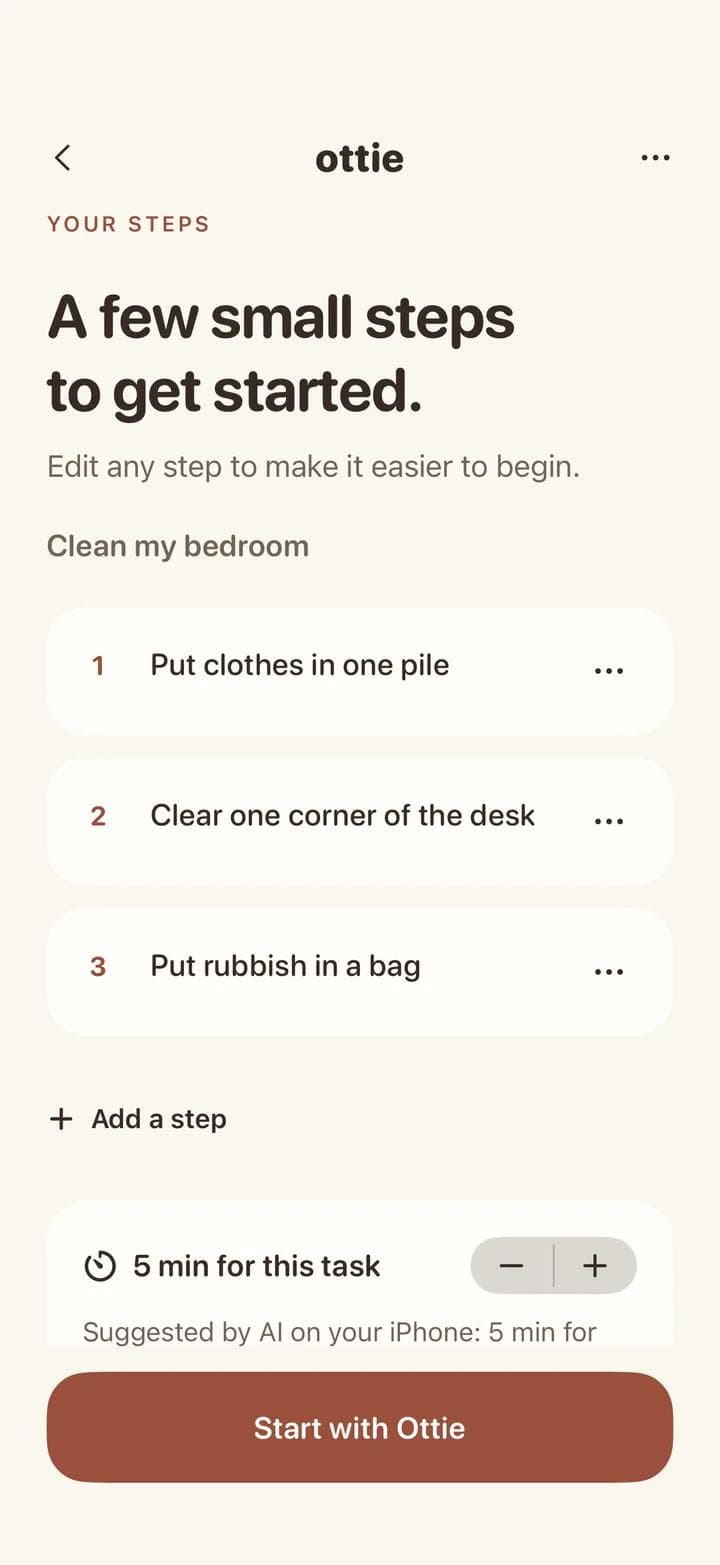
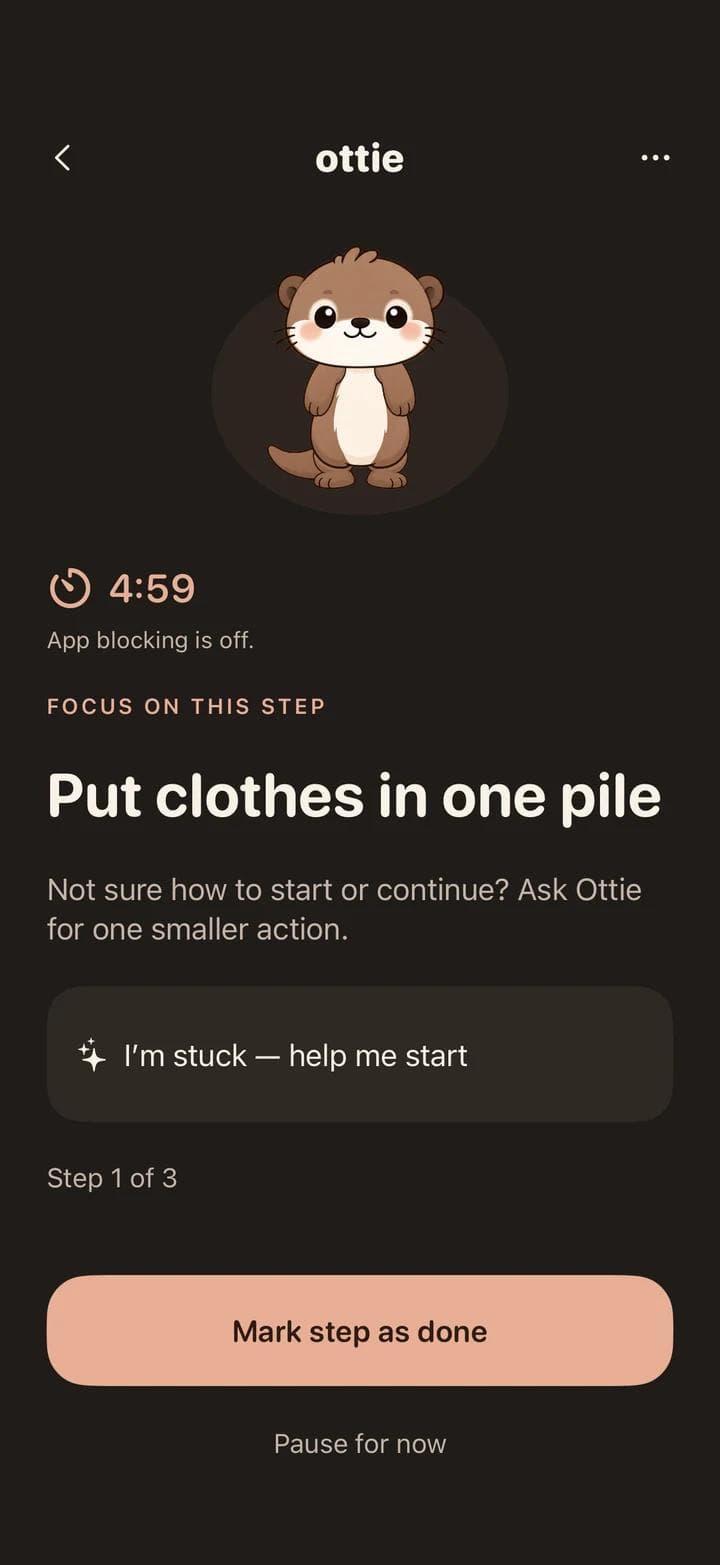
For kids and adults
Different ages. The same first-step challenge.
Ottie adapts the steps and tone to each person, adult or child, to make that first move feel more manageable. The language, encouragement and small actions share one goal: moving at your own pace, one task at a time, without judgment.
The flow
One task. A few steps. A first move.
Describe what needs doing
A sentence and, when it helps show the situation, a photo of the desk or room that needs attention.
Make the steps your own
Ottie suggests three to four five-minute phases, each split into two concrete actions. The steps can be edited before starting.
Start with Ottie
One action and its timer on screen. If starting still feels hard, “I’m stuck” asks AI for an even smaller action.
Presence, attention & research
Starting with company. A direction to explore.
Body doubling means doing a task in another person’s presence, in person or remotely. People use this company to help them start and stay on track. [1]
User survey · 2024
220
people surveyed
Company as a starting point.
Including 139 who self-identified with ADHD. Responses describe body doubling as support for getting started, staying on task and following through. [1]
Self-reported survey without a control group: it describes a practice, not clinical effectiveness.
Exploratory study · 2025
8.49 → 10.82
correctly placed bricks per minute
An early signal in virtual reality.
Among 12 adults with ADHD, average output rose from 8.49 alone to 10.82 with a human partner in a virtual reality construction task. [2]
Preprint, small sample and a laboratory task: the result cannot be generalized to everyday life.
Randomized trial · 2026
−5 points
on the ASRS symptom score at 3 months
Digital tools can support care.
Among 337 adults with ADHD, attexis, a cognitive behavioral therapy and mindfulness program added to usual care, produced a score 5 points lower than usual care alone (adjusted mean difference). [3]
Specific to attexis. Unblinded trial, self-reported outcomes, funded by its developer GAIA.
What Ottie takes from this
Reassuring company, one action at a time and visible time cues: these studies inform Ottie’s design choices. The product hypothesis is to make starting feel more manageable, without pressure.
These studies do not test Ottie or the effect of its mascot. Its benefits still need evaluation; findings in adults do not establish benefits in children. Ottie is everyday support, not an ADHD treatment.
Attention
Less to juggle. One first step within reach.
Ottie is designed for moments when starting, choosing a priority or staying on track takes extra effort — including for people with ADHD. One task at a time, concrete actions, a visible timer and help when you get stuck: the flow offers simple cues without judgment or pressure to perform.
Focus
Make room for the task you chose.
Focus mode lets users choose which apps to put on hold through Apple’s Screen Time controls. For tasks with a visible result, a photo can be submitted to the AI model to request an unlock. The timer ending does not mark the task as complete; an explicit exit also lets users abandon the session. This flow is optional.
The character
A little otter, there at the right moment.
Ottie tidies its desk during onboarding, plays with a padlock while apps are selected and celebrates a completed task. Swift and Metal power the scenes, while a speech bubble holds AI-generated encouragement and gentle teasing. Animation pauses in the background, and a still pose respects Reduce Motion.
The implementation
Local and cloud models. One native experience.
SwiftUI provides the interface and SwiftData preserves progress. The intelligence layer uses Apple Foundation Models and its support for other LLMs to integrate local and cloud AI models. Text and photos inform the task breakdown and help users find a way forward when they feel stuck. The experience stays native, with French, English, dark mode, Dynamic Type and VoiceOver.
The Apple ecosystem
A fully native Apple experience.
Ottie brings SwiftUI, SwiftData, Metal, Apple Foundation Models and StoreKit together in a fully native experience. Siri AI and App Intents extend the flow into system interactions, while iPhone Duo compatibility brings Ottie to that form factor. Dark mode, Dynamic Type, VoiceOver and Reduce Motion are part of the design.
Ottie Plus
More possibilities. Still one small step at a time.
Ottie Plus unlocks unlimited task breakdowns, guided focus sessions, app blocking and photo checks. Calendar and reminders integration helps make room for tasks in your day, while even more powerful AI models offer richer guidance. More ways to find a starting point whenever a task feels too big. Monthly or annual subscriptions are available right in the app through Apple’s native purchase experience.
From the first step onwards
Small wins make a big day.
One plate washed. A corner of the desk cleared. That email finally sent. Ottie makes room for these small wins, with just enough structure to move forward and an otter to celebrate along the way. The ambition: make the next step feel simple enough to start right now.
Scientific references
The studies behind these figures, including their methods and limitations.
Eagle, T., Baltaxe-Admony, L. B. & Ringland, K. E. (2024). “It Was Something I Naturally Found Worked and Heard About Later”: An Investigation of Body Doubling with Neurodivergent Participants. ACM Transactions on Accessible Computing, 17(3), article 16.
Ara, Z. et al. (2025). You Are Not Alone: Designing Body Doubling for ADHD in Virtual Reality. arXiv:2509.12153v1 · Preprint.
D’Amelio, R. et al. (2026). Effectiveness of attexis, a digital intervention based on cognitive behavioral therapy for adults with ADHD: a randomized controlled trial. Psychological Medicine, 56, e54.