Meet Claude, Anthropic’s API: explore document analysis, computer vision, prompt caching, text generation, pricing, and practical ways to build with LLMs.
2024 is definitely the year of AI (AI here, AI there, AI at lunch, AI at the Élysée — we’ll talk about that in 2025). So of course I had to write something about it. Maybe two pieces, or three… I don’t know, you know how it goes.
On a freezing December day (yes, it pours in Lille too), let me tell you about an API that has changed how we build our projects. Let me tell you how Santa finally decided to modernize his supply chain. No more overworked elves sorting letters by hand, no more rough estimates of how many cookies are needed for the worldwide trip. This year, the big bearded guy is switching to AI with Anthropic’s API!
🎁 Who is Uncle Claude?
Imagine an API that understands your users as naturally as an elf understands Christmas lists. That’s Claude: a natural-language interface (an LLM) that plugs straight into your apps and makes them smarter, more responsive, and more personal.
The Claude family has three models, like the three wise men (following the star with their eyes in Galilee):
- 🚀 Claude 3 Haiku: the fast one, perfect for everyday interactions
- 💼 Claude 3 Sonnet: the all-rounder, a great balance of performance and speed
- 🎯 Claude 3 Opus: the sophisticated one, for tasks that call for deep expertise
💡 Claude’s secret superpowers
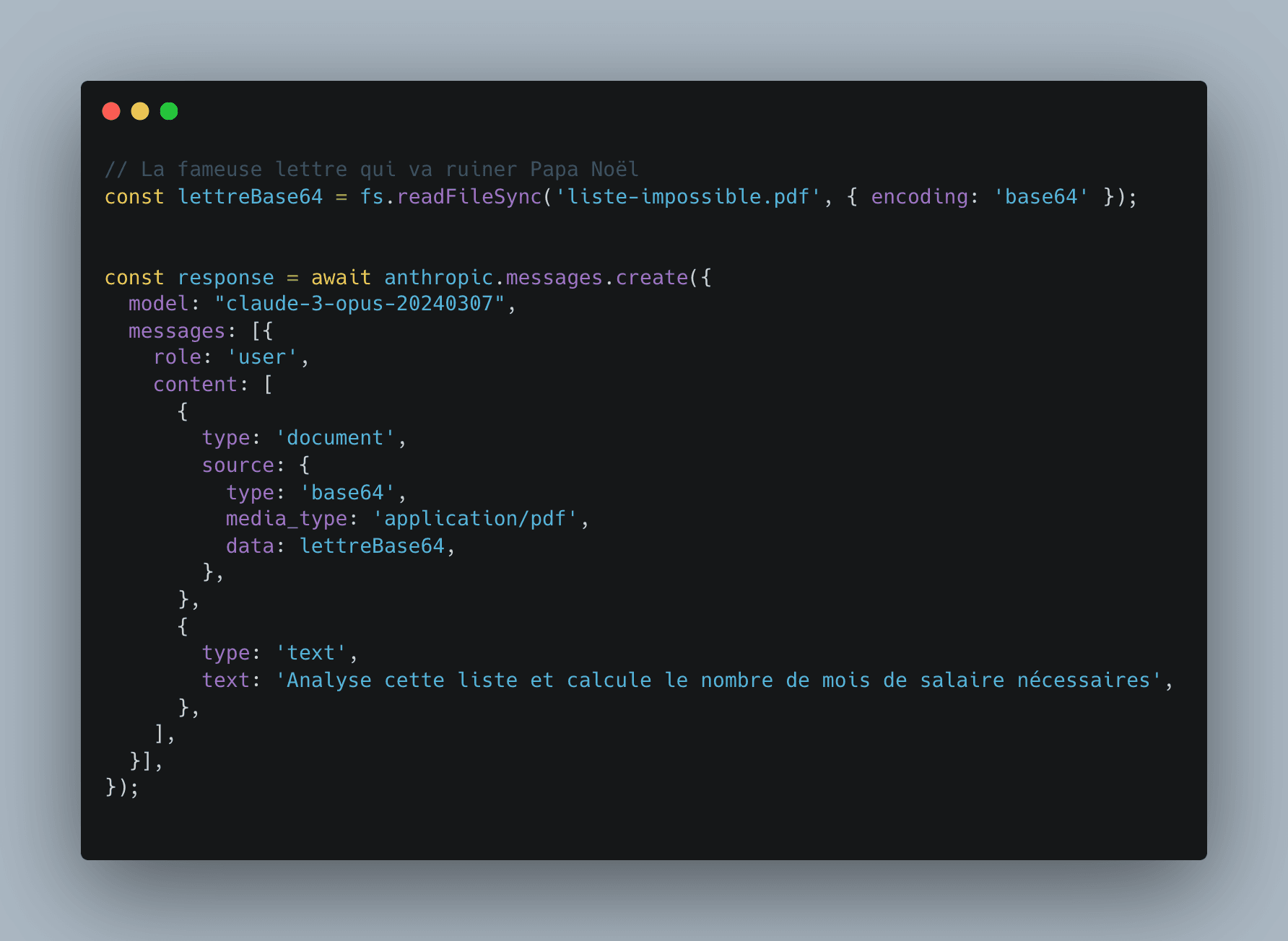
📄 The North Pole letter decoder
Not only can it read your five-year-old nephew’s barely legible handwriting, it can also predict whether the gifts he’s asking for will make his parents’ bank accounts cry. Magic!
👁️ The Christmas decoration expert
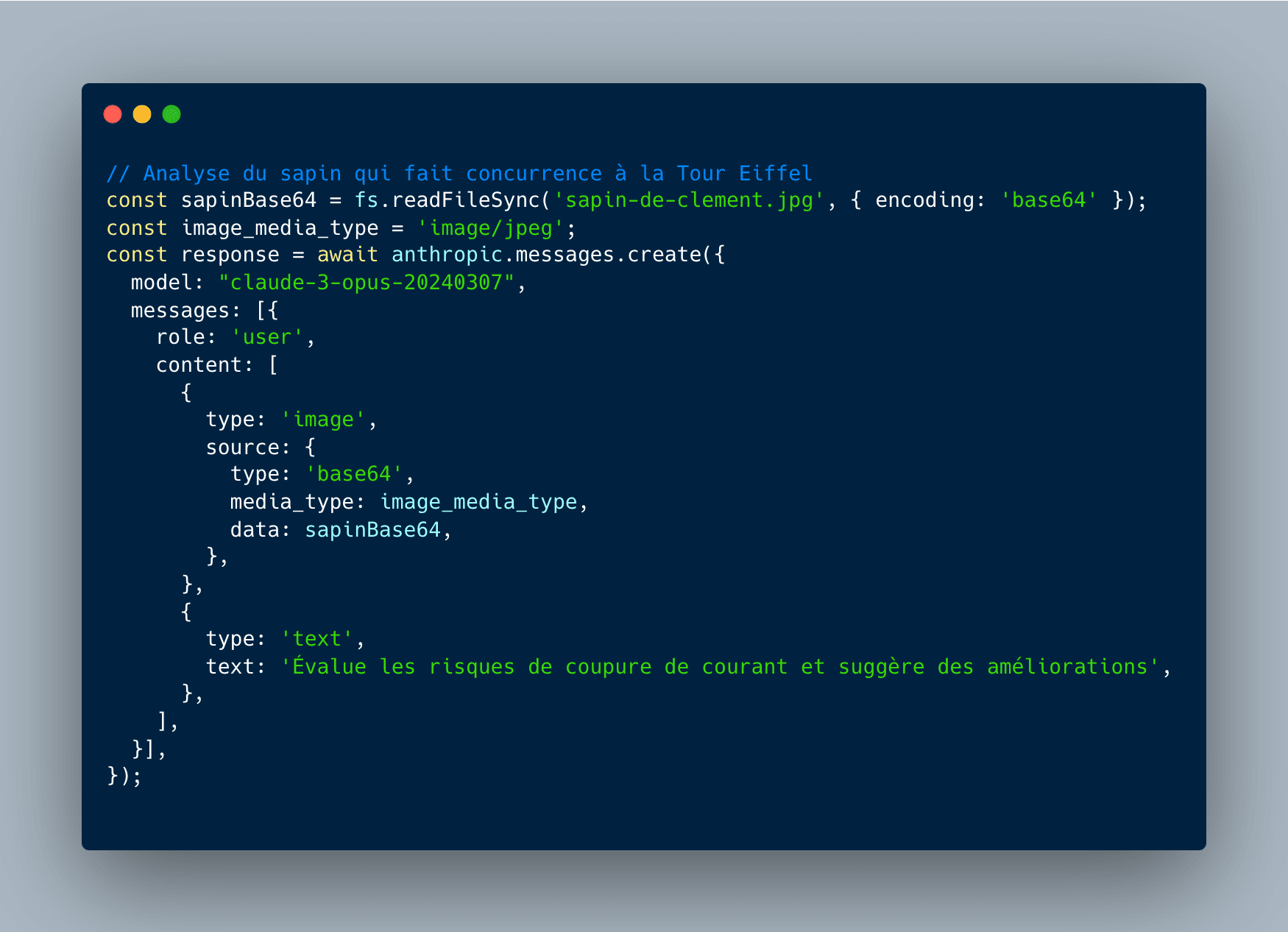
It can analyze your tree and diplomatically tell you that putting all the red baubles on one side is not an “artistic choice.” It can even work out whether your string lights might cause a blackout across the whole building (what do you mean three extension leads are too many?).
🎯 Prompt caching: or how Claude remembers everything (even your 1995 Christmas lists)
You know that awkward moment when your aunt asks whether you remember the present she gave you last year? Claude doesn’t have that problem! Thanks to prompt caching, it remembers everything — like Santa with an elephant’s memory (minus the red suit).
Prompt caching is a bit like preparing all the gift wrap in advance: it saves you a lot of time on the big day. Instead of processing the same information over and over (like explaining for the hundredth time how Grandma’s new smartphone works), Claude keeps important context available.
Here’s how to give Claude an elephant’s memory:
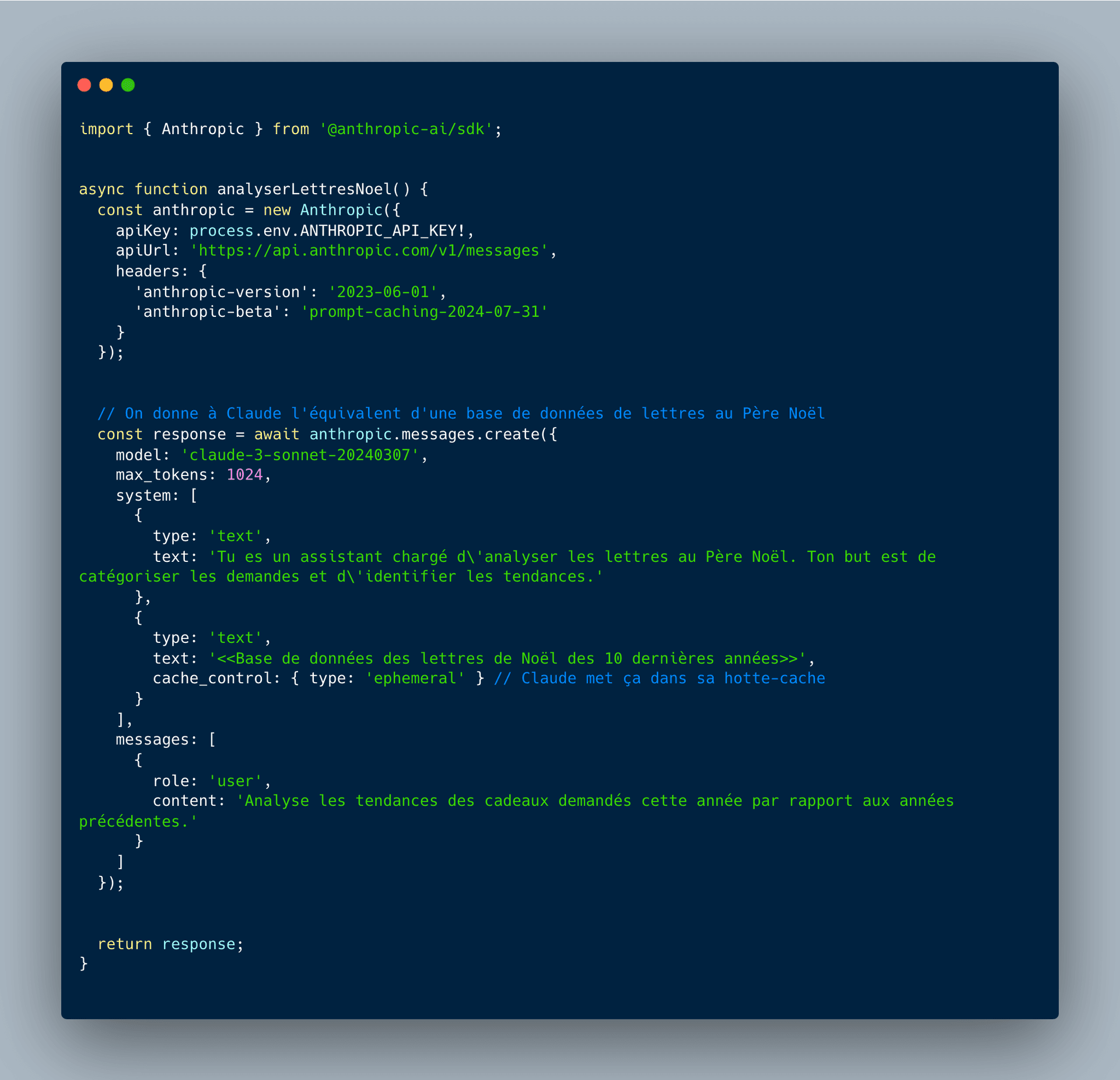
Think of it as Santa’s big magic book: instead of rereading it every time a child asks for a PS5 (sorry, parents), Claude keeps the information in memory. That’s especially useful when you have:
- A database bigger than Mom’s Christmas shopping list
- Data that changes less often than the Christmas sweater Aunt Jacqueline gave you
- Analyses that come around more often than “All I Want for Christmas” in December
The cache_control option with type: 'ephemeral' is like telling Claude, “Put this somewhere safe; we’ll need it later.” It can speed up future responses, a bit like preparing gift tags in advance!
Pro tip: if you’re processing data as large as Santa’s nice list, prompt caching can really save the day. And unlike Santa’s cookies, it won’t make you put on weight! 🍪
💰 Pricing, explained with Christmas presents
Let’s talk money (but not in front of the kids; it’s Christmas). Claude’s pricing is as transparent as a crystal bauble:
🍫 Claude 3 Haiku — the tasty entry-level option
At $0.25 per million tokens, it costs about as much as a box of Merci© chocolates (yes, the ones you recycle as emergency gifts every year). Great for getting started and testing the API without putting the Christmas dinner budget at risk.
🎂 Claude 3 Sonnet — the traditional menu
$3 per million tokens — about the price of a lovely artisan Christmas log (not the €5.99 supermarket one). The best value for most projects, like Grandma’s homemade foie gras.
🎁 Claude 3 Opus — the luxury choice
$15 per million tokens, about the price of that luxury perfume your mother-in-law “loves” (but quietly resells on Vinted on December 26). The Rolls-Royce of models, for when you need the very best.
And the good news? No need to take out a bank loan like you do for Christmas presents: you pay only for what you use, with no commitment or hidden fees. Even my banker(s) couldn’t find anything to complain about! (Adeline, Charlotte, Aurélien, a kiss before the traditional chocolates.)
Tokens are a bit like the metric system for AI. In practice, one token is roughly a quarter of a word in French. For example, “Joyeux Noël” is about 3–4 tokens, because some words are split into smaller pieces.
To give you a better idea:
- A standard page (500 words) = around 650–750 tokens
- Harry Potter and the Philosopher’s Stone = around 120,000 tokens
- The complete Lord of the Rings trilogy = around 400,000 tokens
So, with a million tokens on Claude 3 Sonnet ($3), you could analyze:
- ⚡️ Roughly the whole Harry Potter series
- 📩 Or around 3,000 work emails
- 📚 1,300 pages of technical documentation
In short, even with the premium Opus model ($15 per million), an in-depth analysis of a standard business document costs a few cents. That’s cheaper than a coffee, and a lot more useful than a cup of machine decaf!
🎯 The other players in the AI market
In the fast-moving generative AI ecosystem, several companies are competing for a slice of the (Christmas) pie. Let’s take an objective look:
OpenAI (GPT-4o / o1)
The most talked-about player, with a huge community. Its strengths are versatility and raw power, though the price can climb faster than a reindeer on an icy roof. Of course, we’ll talk about OpenAI in more detail.
Google (PaLM/Gemini)
The Mountain View giant offers a solid alternative with Gemini. It’s excellent at data analysis and multimodal processing, but integration can be as complicated as explaining to Grandpa how to walk on his new connected rug. The documentation is thorough, but often requires a PhD in Google-ology.
Meta (LLaMA)
The open-source approach is appealing, especially for companies that want full control. But you need serious infrastructure and a strong technical team (like us, for example 😅). It’s a bit like building your own sleigh: satisfying, but time-consuming.
Cohere
A quieter but serious player, especially effective for enterprise use cases. Its pricing model is interesting, though its community is smaller than those of the market leaders.
🎁 Claude’s well-kept secrets
Beyond the obvious features, Claude has a few aces up its sleeve:
Impressive contextual understanding
Where other models can lose the thread like an elf after too much mulled wine, Claude stays remarkably coherent through long, complex conversations. It can follow a winding technical argument without losing sight of the original goal.
Built-in ethical safeguards
Claude includes ethical guardrails without compromising performance. It’s like having a built-in moral advisor who stops you doing something silly, without Aunt Berthe’s preachy side.
Natural language adaptation
It naturally adapts to the technical level and communication style of the person it’s talking to. From junior developer to seasoned CTO, everyone gets answers suited to their level.
Smart project management
Its ability to understand technical specifications and suggest pragmatic solutions makes it an excellent project assistant — even when the requirements document looks like a disassembled Christmas tree.
🎄 A guide to advanced and unexpected uses
Business process optimization
- Automated analysis of customer feedback with intelligent categorization
- Context-aware personalized report generation
- Decision support based on historical data
- Automated technical documentation (that doesn’t smell like copy-paste)
Development support
- Preliminary code review and optimization suggestions
- Intelligent unit test generation
- Assisted debugging with contextual analysis
- Turning specifications into structured user stories
Marketing and communications
- Adapting content for different platforms
- Sentiment analysis on social media
- Personalizing communications at scale
- Smart SEO optimization
And a few more… creative uses 🎪
- 📅 Coming up with creative excuses for missed deadlines (I don’t recommend it, but it does it very well)
- 🎁 Predicting gift trends (handy for chronic last-minute shoppers)
- 🪑 Optimizing seating plans to avoid family drama
- 🎯 Suggesting New Year’s resolutions you might keep for more than 48 hours
- 🎨 Calculating how much wrapping paper you need based on the wrapper’s clumsiness (some of us need three times as much as everyone else)
- 👣 Making excuses for why Santa’s footprints look suspiciously like your slippers (with elaborate scenarios involving temporary contract elves)
- 🎵 Writing startup versions of Christmas songs (“Dear Product Owner, when you come down from the cloud / Don’t forget my user stories / My KPIs are all in the red / I really wish you’d fix them”)
❤️ Why I like Claude
In this “24 Days of APIs” series, I promised zero bullshit and real-world feedback only. No marketing magic dust or disguised product placement. Today, three of our clients actively use Claude in production, from an early-stage startup to a (very) large enterprise.
Documentation as good as chestnuts (like onions, but better in winter)
Unlike some APIs that seem to have been documented by an intern eager to leave for Christmas vacation, Claude’s API documentation is clear, well structured, and regularly updated. The examples work the first time (yes, really), and onboarding is as smooth as an ice cream log.
A simple, flexible integration
It’s probably the easiest API I’ve integrated this year. Even my colleague who still codes in jQuery (no judgment, it’s Christmas) got it working in less than a day.
Pricing that won’t make you sell a rei[n]deer
In a world where some providers charge you for every semicolon, Claude offers transparent, predictable pricing. The free tier is generous enough for serious testing, and scaling up doesn’t require a funding round.
Support that replies faster than my niece on Christmas morning
I’ve exchanged a few messages with their support team about detailed technical questions. They respond quickly and, more importantly, actually understand developer problems. No generic automated replies or “Have you tried restarting your computer?”
(Actually, I’m being very unfair to my niece. She’s wonderful, and 2024 will be her first Christmas… Sixtoo, your uncle loves you ❤️)
Performance that holds up
In terms of raw performance, Claude stands out for:
- Consistent answers, even at scale
- High-quality streaming for long responses
- Intelligent context management
If you’re looking for a generative AI API for a serious project, Claude will be a great ally for 2025. And no, they didn’t pay me to say that — although a little Christmas present would be welcome, if anyone at Anthropic is reading 😉.
🎹 To wrap up
Claude is a bit like Santa in the tech world: always there when you need it, doesn’t ask too many questions, and delivers the goods. If you want to boost your productivity in 2024, it’s the perfect gift to give yourself!
🚀 About me
I’m Clément. When I’m not testing APIs or debating whether Santa Claus exists, I build innovative products at BnC Consulting. If you have a tech project that deserves more than a letter to Santa, we should talk!
Happy holidays and happy shipping! 🎄🚀