
On a Monday call, a construction business owner offered me €1,200 for a renovation marketplace, since "AI can do it in three prompts." I told him to try. What three prompts actually produce, what would have happened if I'd said yes, and what you're really paying for when you hire a developer in 2026.
Mondays are my call days.
I deliberately leave my calendar open for prospective clients. It's a good way to start the week: hear about new ideas, meet business owners and talk about something other than Swift, architecture or Apple's latest announcements.
I usually have four to six calls. A couple won't go anywhere — the idea is still vague, the budget doesn't add up, or the timing is wrong. Then there are two or three promising conversations with people who know what they want to build and why. Even when nothing comes of it, I tend to learn something.
And sometimes one call deserves an article of its own.
This one lasted less than ten minutes.
On the other end was a construction business owner in his forties. He'd been running his company for about a decade and had a genuinely interesting idea: an app for homeowners planning renovations. Take a photo of a room to get an initial cost estimate, find tradespeople, compare quotes, follow the work and pay invoices.
He knows his industry. He knows how hard it can be to compare quotes, manage delays and find reliable people. That's not a bad place to start a product.
But the feature list grew quickly. AI to analyse photos. Separate accounts for homeowners and tradespeople. Messaging, notifications and secure payments. iPhone and Android, naturally. Plus a dashboard to run the marketplace.
“Nothing too complicated these days, with AI.”
Oh, and he'd like to launch next month.
Then came the budget: €1,200.
For context, the projects I take on generally fall between €10,000 and €50,000. What he'd just described sounded more like a substantial two-sided marketplace than a little app you throw together over coffee.
He must have caught my expression, because he added straight away:
“Honestly, with AI you can do that in three prompts now, can't you? I'm mostly paying you to press the button.”
I smiled. “Then give it a try. Seriously.”
He looked taken aback. Perhaps he expected a negotiation, a cheaper version or a long defence of developer rates. But if his app really can be built in three prompts, he doesn't need to pay me. If it can't, we're simply not talking about the same budget.
I'm not making fun of him. He knows his trade and is trying to apply what he's seen in AI demos to a new project. I completely understand the reasoning.
I have a lot less patience, though, for the weekend vibe coders who put those ideas in his head.
You know the ones. They discovered Codex (or Claude) on Tuesday, generated three screens on Wednesday and woke up on Thursday with a software engineering degree they found in the lucky bag Grandma gave them last Christmas.

By Friday, they were Founder & CTO. On Saturday, they were posting a LinkedIn thread titled “Why Software Engineers Are Dead”. By Sunday, they were selling a €499 course on replacing a team of twenty developers with three prompts written in broken English.
Their technical expertise? Copying and pasting an error message into ChatGPT. Their architecture? “I let the AI choose.” Their security strategy? “It works on my Mac.” Their production experience? A Deploy button turning green on Vercel.
And when their house of cards finally collapses, they're stunned to discover that users have personal data, payments involve real money, and you can't repair a database by asking “fix everything please”.
But the most fascinating part is their sheer nerve. People who couldn't have explained what an API was six months earlier are now lecturing professionals who've been shipping software for fifteen or twenty years on architecture, productivity and engineering.
Let's be clear: I have no problem with anyone learning to code with AI. Quite the opposite. I think it's fantastic that these tools make development accessible to more people.
What I can't stand is confusing access to a tool with mastery of a trade.
Buying a cement mixer doesn't make you a bricklayer. Watching three YouTube tutorials doesn't make you an architect. And asking Claude to generate 40,000 lines of code you can't read doesn't make you a software engineer.
It makes you someone who owns 40,000 lines of code they don't understand. Congratulations.
The problem isn't even that they believe it. It's that, by turning their ignorance into viral content, they end up convincing perfectly serious business owners that our job now consists of watching a progress bar.
So no, I don't blame this construction business owner.
All the less so because he simply believed people who talk about building software with the confidence of those who've never had to maintain what they've built.
Because what he's being shown isn't an app ready for real customers.
It's a trailer. With an affiliate link in the description. (and a pre-roll ad for a VPN)

He's not entirely wrong
Let's start with honesty, because I'd be a hypocrite to skip it.
I work with AI agents every day. I moved my whole content ecosystem to a CMS my agents drive directly (I wrote about it in "Why I Left Hygraph for Sanity"). Claude and Codex write part of the code I ship. I can sometimes get a first pass at a SwiftUI screen in twenty minutes where it used to take half a day.
So yes: AI has dramatically lowered the cost of producing code. Pretending otherwise means defending a moat that no longer exists, and clients can tell. Developers who still insist that "AI can't code" are losing an argument reality has already settled.
But "producing code" and "shipping an app" are two different jobs. The first has become dramatically faster. The second still involves a lot of work, and decisions somebody has to own.
That's where the whole misunderstanding lives.
"Press the button"
That button comment made me smile. I've been hearing it more and more.
"I'm paying you to press the button." Fine. But which button? The one that generates the home screen? The one that picks between Firebase, Supabase or a custom server? The one that decides whether payments go through Apple's in-app purchase or through Stripe — and gets the app rejected if it guesses wrong? The one that answers App Review's email at 11 p.m., the night before launch?
It's not one button. It's a long chain of choices, some of which get expensive when you make the wrong one.
He would understand the comparison immediately: when you hire a tradesperson, you're not just paying for the time spent holding a tool. You're paying for the diagnosis, the experience and the mistakes they avoid.
There's a story told about Picasso that I find perfect. At a restaurant, when the bill arrives, he doodles a sketch on the tablecloth. The delighted owner offers to waive the bill if he'll just sign the drawing. Picasso refuses: "I want to pay for the meal, not buy the restaurant."

The sketch took him a few seconds. The signature, even less. But Picasso knew exactly what they were worth: not the time spent holding the pencil, but a lifetime learning where to put it down.
AI hasn't changed the moral of that story. It's just made the motion even faster.
If I asked him to redo my bathroom for €1,200 on the grounds that, with his modern tools, “all he has to do is press the button on the drill”, I think he'd react exactly as I did.
Tools save time. They don't make the work disappear.
What three prompts actually produce
Let's do the exercise honestly. Three good prompts, a good model, one afternoon. What do you get?
- Clean screens that look like an app.
- Navigation that works in the simulator.
- Hard-coded data, or a local database.
- A "payment" that shows a lovely confirmation screen while not a single cent moves.
- A login flow that looks finished without having been properly security-tested.
That's impressive. Genuinely. But it's only the beginning, and usually the most photogenic part — the part you can see, the part that goes in the videos.
What those videos rarely show is the moment a prototype meets its first real customers.
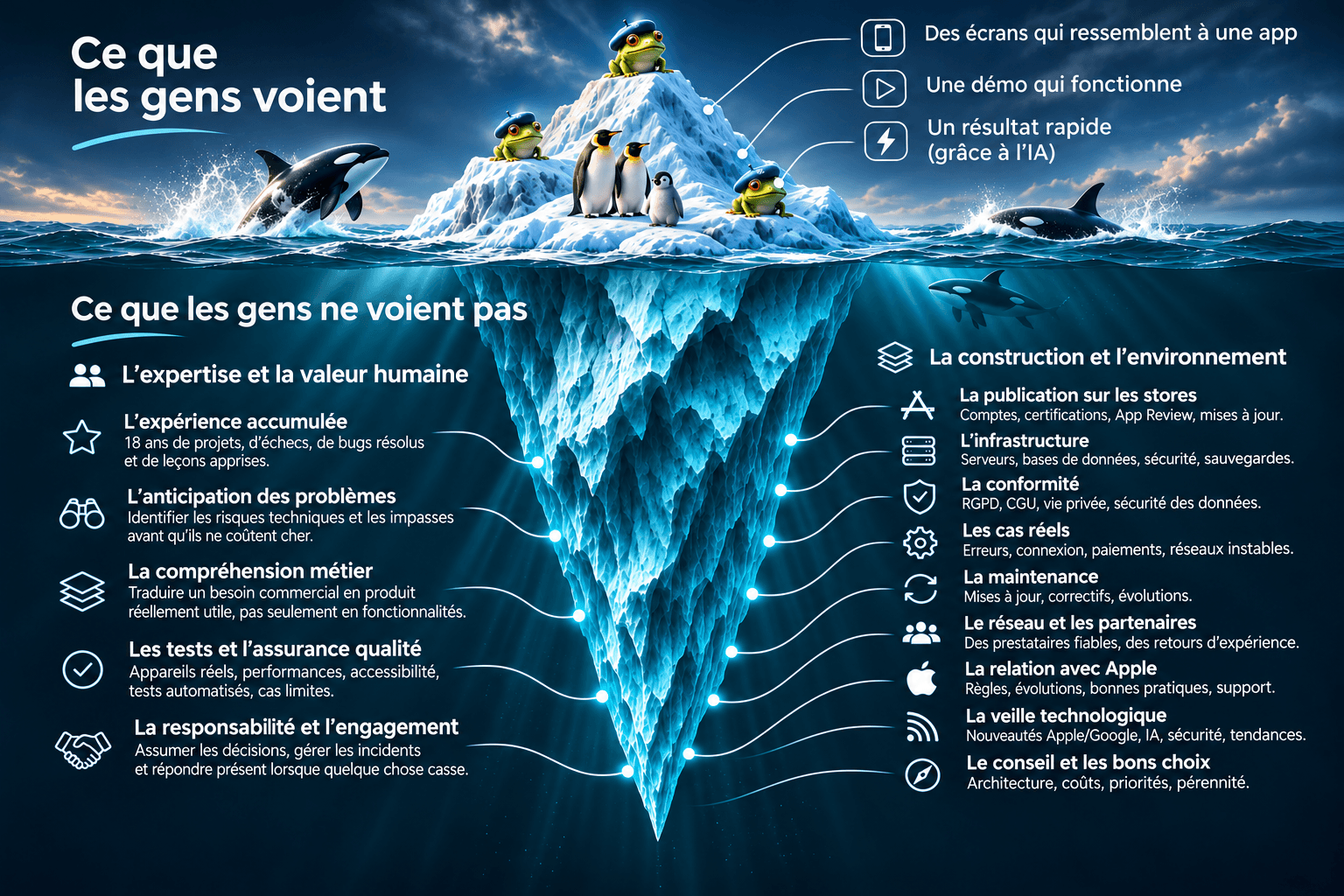
What they don't produce
Here's a non-exhaustive list of what separates that demo from an app in your customers' pockets.
To exist on the stores
- An Apple Developer account (US$99 a year, before any applicable taxes) and a Google Play account, in the right name, with the right paperwork. In your company's name, not the freelancer's who'll vanish in six months with the keys.
- Code signing, certificates, provisioning profiles — which expire, always at the worst time.
- App Store and Play Store listings: screenshots for every screen size, copy, keywords, age rating, privacy labels.
- Apple's review, which can reject the app for reasons three prompts know nothing about: a badly integrated payment, an unjustified mandatory login, a missing privacy policy, a feature set deemed "too thin" to deserve an app.
To actually work
- A server, a database, secure user accounts, a forgotten-password flow that doesn't let just anyone into just anyone's account.
- Real payments, with their rules: Apple requires in-app purchase for some content and not for others. Get it wrong and you're rejected — or stuck with a commission your business model never accounted for.
- Appointment slots that don't get booked twice, leaving two customers waiting for the same tradesperson.
- Photo-based estimates clearly presented as guidance, not guaranteed quotes.
- Notifications that arrive on real devices, rather than hours late.
- Personal data handled in line with GDPR. Simple question: on the day it leaks, who's accountable? Hint: not the language model.
To last
- Testing on real iPhones, real entry-level Android phones, real screen sizes, real 4G in a subway tunnel.
- An accessible app: VoiceOver, Dynamic Type, contrast.
- A new version of iOS every year, which always breaks something. And Android, which breaks something else.
- Fixes, user feedback, updates, one-star reviews to handle. An app doesn't stop needing attention when it goes live. That's when the real-world feedback begins.
None of this shows up in a demo. All of it shows up the day it's missing.
What if I'd said yes?
Let's play it all the way through. Say I'd taken the €1,200. Here's roughly how the story would have gone.
Week 1. I generate the screens. Gorgeous. The client is delighted. He shows the screenshots to his business partners. Everyone loves it. It's the best moment of the project, and it won't come back.
Week 2. We hook up a real backend. We need to pick a host, set up authentication, model the bookings. My €1,200 is already spent. From here on, I'm working for free.
Week 3. Payments. We have to map the money flowing between homeowners and tradespeople. Payments for physical services follow different rules from digital purchases. Then there are deposits, refunds and invoicing to deal with. "But the AI didn't tell me that." No. It didn't tell you anything, because you didn't ask.
Week 4. First App Store submission. Rejected. Missing a privacy policy, a way to delete your account from inside the app, and working demo credentials for the reviewer. Every fix means a new submission, and every submission means a few more days of waiting.
Week 6. The app is live. The first users arrive. Two of them book the same slot at the same moment. A quote reaches the wrong homeowner, exposing someone else's address and renovation budget. Panic. A call at 10 p.m.
Week 8. The owner reminds me, fairly enough, that he paid for an app that works. He's right. I agreed to a price that made it impossible for it to work. I'm wrong too. And we both lose: he ends up with a shaky app, I end up with three weeks of unpaid work and an unhappy client who's going to talk about it.
That's why I refuse this kind of project. Not to defend my rate on principle, but because I can see where it's heading. A bad price never produces a good app. It produces an argument, slightly delayed.
What you can actually do with €1,200
Let's run the math nobody runs.
At my rates, €1,200 is roughly a day and a half of work. Not an app: a day and a half. Taxes, social charges, software, hardware and developer accounts included.
And that day and a half doesn't just pay for time in front of a screen. It pays for eighteen years of App Store. Eighteen years of breaking my teeth on baffling Apple rejections, on servers going down on launch night, on bugs that only show up on one iPhone model, in one language, on a Tuesday. Eighteen years of building a network: contacts across the Apple ecosystem, fellow developers who've already solved the problem you're about to hit, partners I can hand off what I don't do myself.
That's the signature at the bottom of the sketch.
In a day and a half I can do a lot of useful things. I can scope your project, tell you what will be expensive and why, separate the essentials from the nice-to-haves, check that your business model holds up under Apple's rules, and save you six months heading in the wrong direction. It's often the best-value spend in the whole project.
What I can't do in a day and a half is commit to a production app with users, payments and personal data. Because at the end of the day, that's what you buy when you pay an experienced developer in 2026:
- Not lines of code. AI writes those, and that's fine.
- Decisions. Which backend, which architecture, what not to build. Above all, what not to build.
- Accountability. Someone who knows why it broke, and who picks up the phone when it does.
AI has lowered the price of code. It hasn't lowered the price of judgment. If anything, it's raised it: when anyone can generate a thousand lines in a minute, knowing which ones to keep becomes the scarce skill.
What AI actually changed in my quotes
People ask me this a lot, so I'll answer plainly: yes, AI has changed how I price.
Just not in the direction people imagine. My projects don't cost ten times less. They go further for the same budget. Where a €20,000 project three years ago shipped a slightly bare first version, today it ships more features, more tests, better accessibility, an iPad app thrown in, a cleaner back office. The time AI saves me on production, I reinvest in what AI does badly: architecture, quality, dealing with Apple, and the product itself.
AI hasn't divided the price of an app by ten. It has multiplied what you get for the same price. Those are not the same thing, and that's the whole difference.
Anyone promising you the opposite — "the same app for a tenth of the price" — is selling you one of two things: a demo dressed up as a product, or their own bankruptcy a little further down the road.
The real misunderstanding: perceived price dropped, the cost of risk didn't
I don't blame this business owner. The market is sending him a consistent signal: videos where "a complete app" appears in minutes, tools promising to "replace your developer," LinkedIn threads where everyone "built a SaaS this weekend." The perceived price of an app has collapsed.
But the cost of risk hasn't moved a cent. A data leak costs just as much as it always did. An App Store rejection the day before launch costs just as much. An app that crashes for your first customers costs just as much — in money, and above all in reputation. Your users don't care whether the code was written by a human or a machine. They want it to work.
And AI adds a new risk: code nobody understands. I'm starting to receive projects generated end to end that "worked" right up until someone needed to change them. No structure, no tests, dependencies added at random, API keys sitting in plain text inside the app. Taking them over often costs more than starting from scratch, because first you have to figure out what the machine was trying to do. And the machine doesn't remember.
Unsupervised generated code is an adjustable-rate loan: cheap at signing, ruinous at maturity.
Why "go ahead" is real advice
When I suggested he give it a go, I meant it. I still do. Here's why.
You'll learn what you actually want. Nothing clarifies an idea like trying to build it. After a few evenings, you'll know which screens matter, which ones are fluff, and where the real difficulties are.
You'll find out where AI gets stuck. Not on the screens. On publishing, payments, accounts, security, sync. That's where the work is, and that's where the budget goes. You'll find out for yourself, which beats taking my word for it.
You'll come back with a better brief. Maybe even a prototype. A client who has tried shows up with precise questions instead of a vague idea. The project costs less, because we know what we're building. Some of my best client conversations begin with an imperfect prototype on the table.
And maybe you won't need me. If your need fits in a no-code tool, a responsive website, or an internal app for ten people, AI and the right tools are more than enough. I'd rather tell you now than bill you for a native app you don't need. A consultant who sells you everything you ask for isn't a consultant. It's a vending machine.
If your budget really is €1,200
There are smart things to do with that money. None of them is called "a production iOS and Android app."
- A scoping day. You leave with a clear scope, a realistic estimate, and a list of what can wait for version 2. It's also the best way to find out whether your project really deserves to exist as an app.
- An audit of your AI prototype. Generated something? I'll tell you what's reusable, what's dangerous, and what's missing before the stores.
- Market validation without an app. A landing page, a form, a few weeks to check that people actually want what you want to build. Often the best money you'll spend — and the most humbling, because it answers the question nobody wants to ask.
- A smaller MVP. One platform, one user journey, no payments at first. Fewer features, but a real app. Not for €1,200, but for far less than the full version.
A word to fellow developers
If you're a developer, you've probably had this conversation. You'll have it again. And you'll be tempted to say yes, because it's a slow month, because "it'll be a good reference," because "with AI it'll go fast."
Don't.
Every project taken at an absurd price teaches the market that the price is possible. Every shaky app shipped at that price reinforces the idea that an app is, after all, "three prompts." You're not doing the client, yourself, or anyone else in this trade any favors.
Saying no — politely, with reasons, and with something else to offer — is one of the most profitable skills in this job. AI won't take that one away from you.
The short version
No, sir, I won't build your app for €1,200. Not because I look down on AI — I probably use it more than you do. But because at that price, I'd be selling you a demo dressed up as a product, and you'd pay the difference on launch day.
Go ahead. Run your three prompts. I sincerely wish you luck, and I'm curious to see the result.
And if you get stuck at "publish to the App Store," my email hasn't changed. The quote might have an extra zero on it. But there'll be an app at the end.
If you have an app project and want to know what it will really cost — or you have an AI-generated prototype and wonder whether it can become a product — that's exactly what I do with BNC Consulting. Drop me a line.
— Clément
Article originally written in French by the author, based on a call on Monday, 26 October 2026 at 11 a.m. The person involved was informed that I would write an article about our conversation. English translation produced with & illustrations generated with OpenAI tools.