Third Kickstarter campaign of enamel pins for the Apple community. A spinning pin for Apple's 50th anniversary, a collaboration with Baptiste around 9:41, and some thoughts on what we pass on when we build for our own people.
There's something faintly absurd, in 2026, about spending weeks on a metal object three centimeters wide. We live in a world where an iPhone Pro screen renders a billion colors, where Apple Intelligence rewrites my drafts while I sleep, where LLMs sketch in seconds what used to take hours two years ago. And yet here I am again, spending entire evenings arbitrating a gradient on a vector layer, counting notches around a circle, arguing about a curve with Baptiste until the nuance is right. It's the third time. 2021, 2024, 2026. And every time, I tell myself this is the last one. Every time, that's false.
For those landing here cold, a bit of context. If you've never wandered around a late-2010s American tech conference, you might not immediately know what I'm talking about. Pins as a tech-community object really took off in 2017, when Apple handed them out for the first time at WWDC, the year the conference returned to San Jose. They were small, precise, collectible, instantly perfect. The other big tech companies followed almost mechanically: Twilio, Stripe, GitHub, ... just about every serious conference started printing its own pins and scattering them across booths or goodie bags. It became a language of its own: you walked around Dreamforce or Stripe Sessions with a lanyard that told the story of where you'd been, who you'd met, what mattered to you. Then Covid arrived, conferences collapsed, and I worried this ritual would disappear with them. That's partly where the first edition came from.
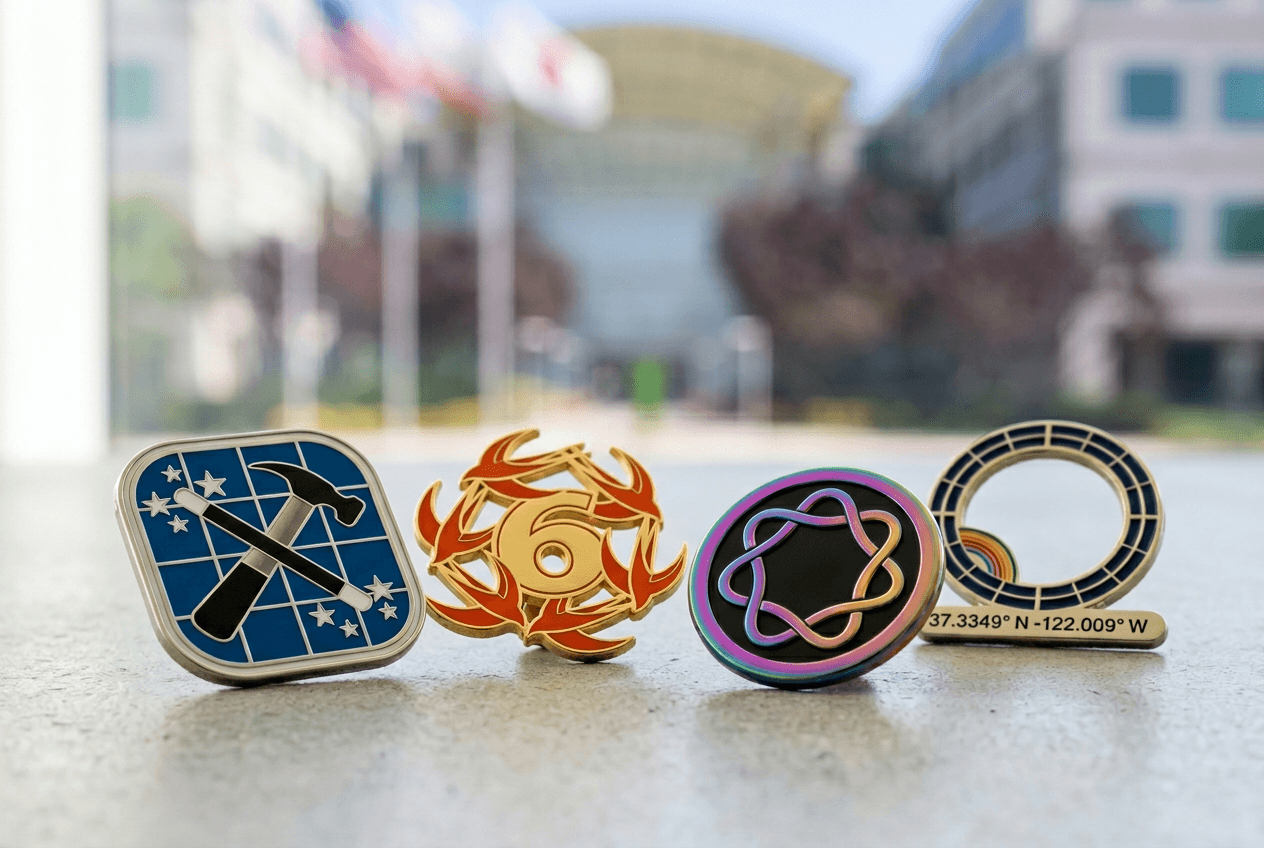
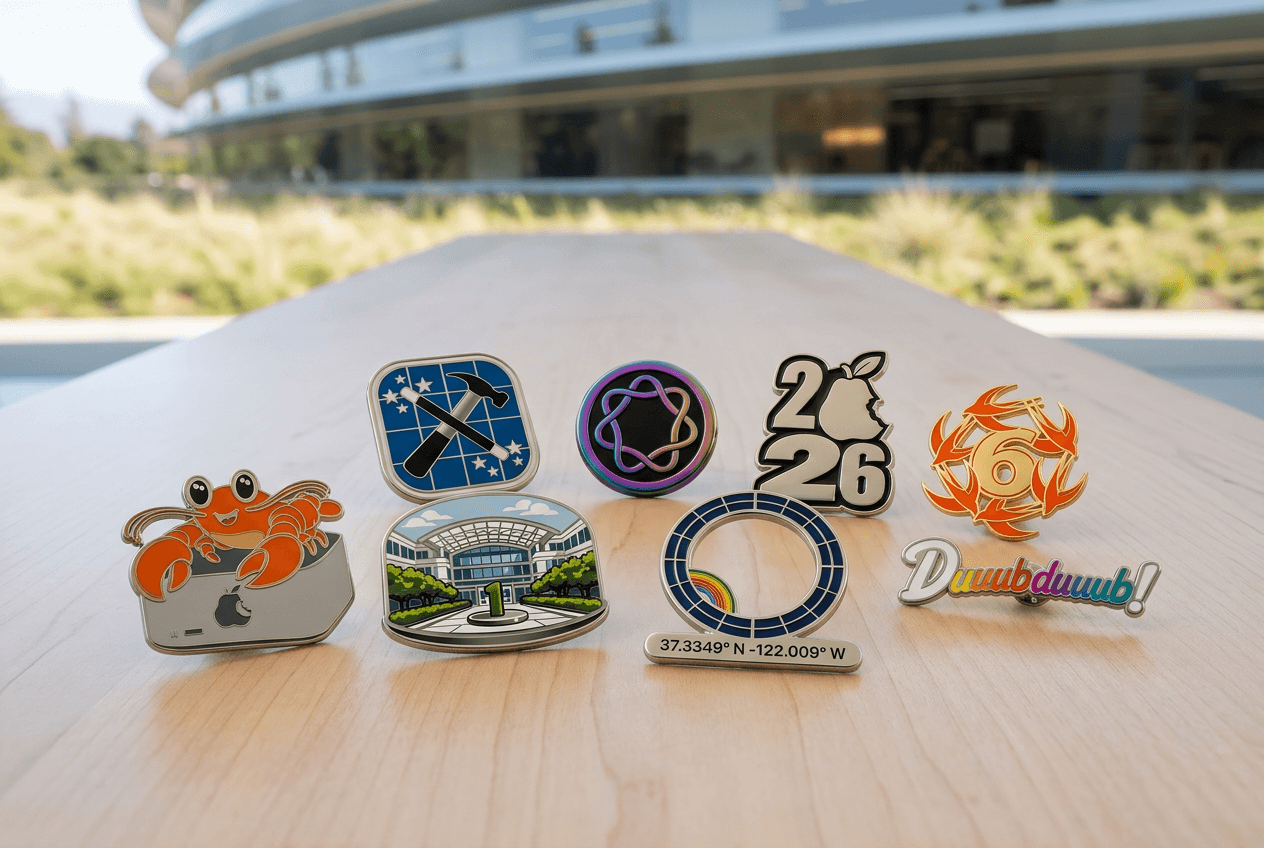
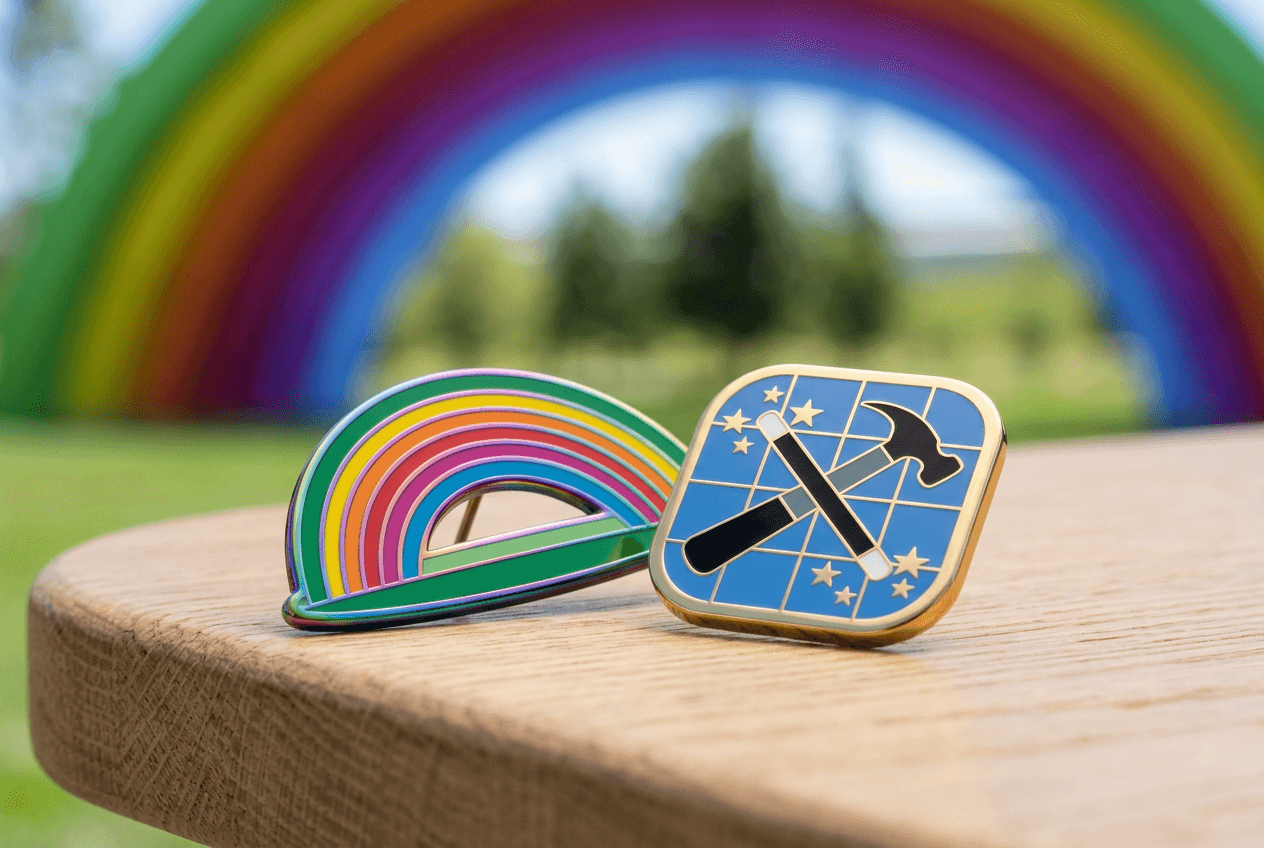
For a few years now, then, every two years as WWDC approaches, I run a Kickstarter campaign to produce a small collection of enamel pins, those metal-and-enamel pins Apple developers love clipping to their event lanyards, bags, and jackets. Each edition tells a moment in Apple culture: a framework that defined the year, an Easter egg that amuses maybe three thousand people in the world, a reference you can only catch if you've been reading iOS release notes since 2008. This year, the 2026 edition includes more than eight pins, a collector tier I'd initially capped at 40 copies at 65 euros, designed as a niche thing for a few diehards, which somehow became the fastest-selling tier to the point that I had to raise the stock to 120, go figure, and one piece I care about especially: the pin for Apple's 50th anniversary. That's the one I want to introduce properly in this article, because it's the most ambitious object I've designed so far, and because it says something about how I see this company after eighteen years building in its wake.
Why I've been doing this since 2021
Let's rewind a bit. The first edition, in 2021, was born during the pandemic WWDC. Everyone remembers that strange period when Apple shifted all-online, when the keynotes became these cinematic objects filmed in an empty Apple Park, when we watched our colleagues from Cupertino deliver sessions from garages repainted for the occasion. It was fascinating to watch, but what I missed, what everyone missed, I think, was the room. The Moscone corridors, then McEnery's hallways when we came back to San Jose in 2017, the ten-minute conversations between labs, the badges proudly clipped to lanyards, the rituals.
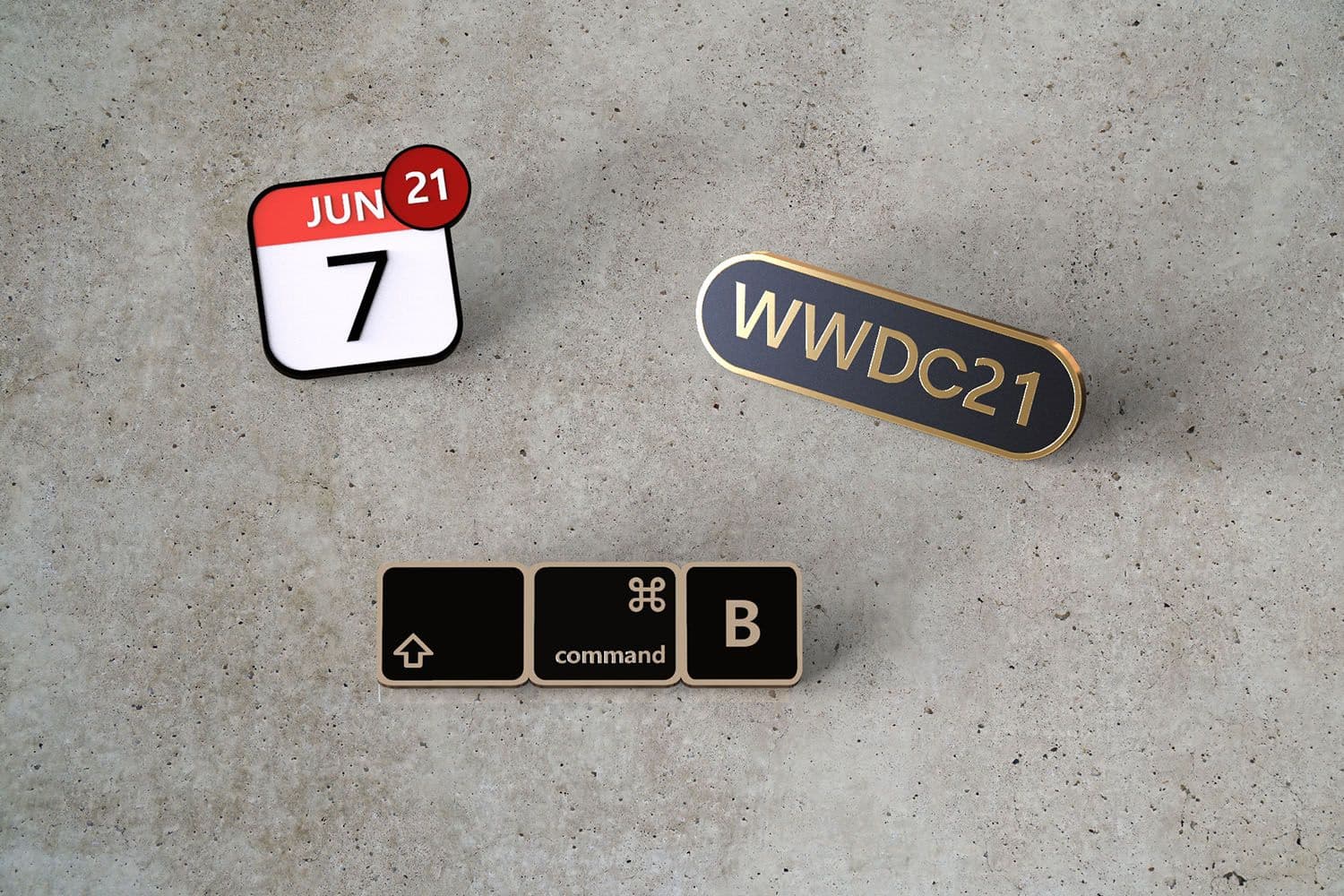
I thought a pin could be a symbolic substitute. A small object you mail to each other to make belonging tangible, even across time zones. That first edition worked far beyond what I'd imagined. Kickstarter backers from seventy countries. Photos of pins on hoodies in Tokyo, Vienna, Sao Paulo. Proof that the community existed even when we couldn't see each other.
Second edition in 2024. The context had shifted. We were back at Apple Park for the hybrid format the company has adopted since 2022: three intense days that begin on Sunday with a mixer at 1 Infinite Loop, continue on Monday with the keynote and the Platforms State of the Union at Apple Park, then end on Tuesday with labs at the Developer Center. Three days, no more. And yet, around those three official days, a whole parallel infrastructure has grown denser: evenings at Paper Plane and Tiki Pete in San Jose, the Duke of Edinburgh in Cupertino, BJ's, Eureka, Lazy Dog, where I'll probably have a drink with you in June if you're reading this sentence. Official WWDC lasts three days. Real WWDC lasts ten.
The 2024 edition confirmed one thing for me: these pins are not products. They're pretexts. Conversation starters. When someone sees the "Concurrency" pin, they know you survived the migration to Swift 6. When they see the "9:41" pin, I'll come back to that in a second, they smile because they know. That shared belonging to a specific, slightly absurd, totally obsessive piece of knowledge is what makes a real community. Not a Discord with ten thousand silent members. Twenty people in a Cupertino pub laughing at the same joke about iCloud Drive changing its icon again.
The collab with Baptiste, and 9:41
This year, I asked Baptiste if we could design a pin together. For those who don't know him, Baptiste is the author of an app called 9:41, a nod to the time frozen on every piece of Apple marketing imagery since the first iPhone keynote in 2007. But first and foremost, he's a friend. We briefly crossed paths at ~~Supinfo~~ Supscam before I bailed to UTC, and we ran into each other again a few years later in the opening-day queue at the Apple Store in Lille. He was third. Guess who was first 😉. Let's just say that designing a pin together in 2026 is, in retrospect, not the most improbable trajectory in history. Look closely at any iPhone ad, any official iPad photo, any keynote slide where a device is shown: it's always 9:41. Why 9:41 and not 9:00? Internal lore says it's roughly the time at which Steve Jobs would introduce the keynote's flagship product; by freezing visuals at that time, the phone on stage and the phone in the marketing image were synchronized. A detail invisible to 99.99% of people. Coded into Apple's visual DNA for almost twenty years.
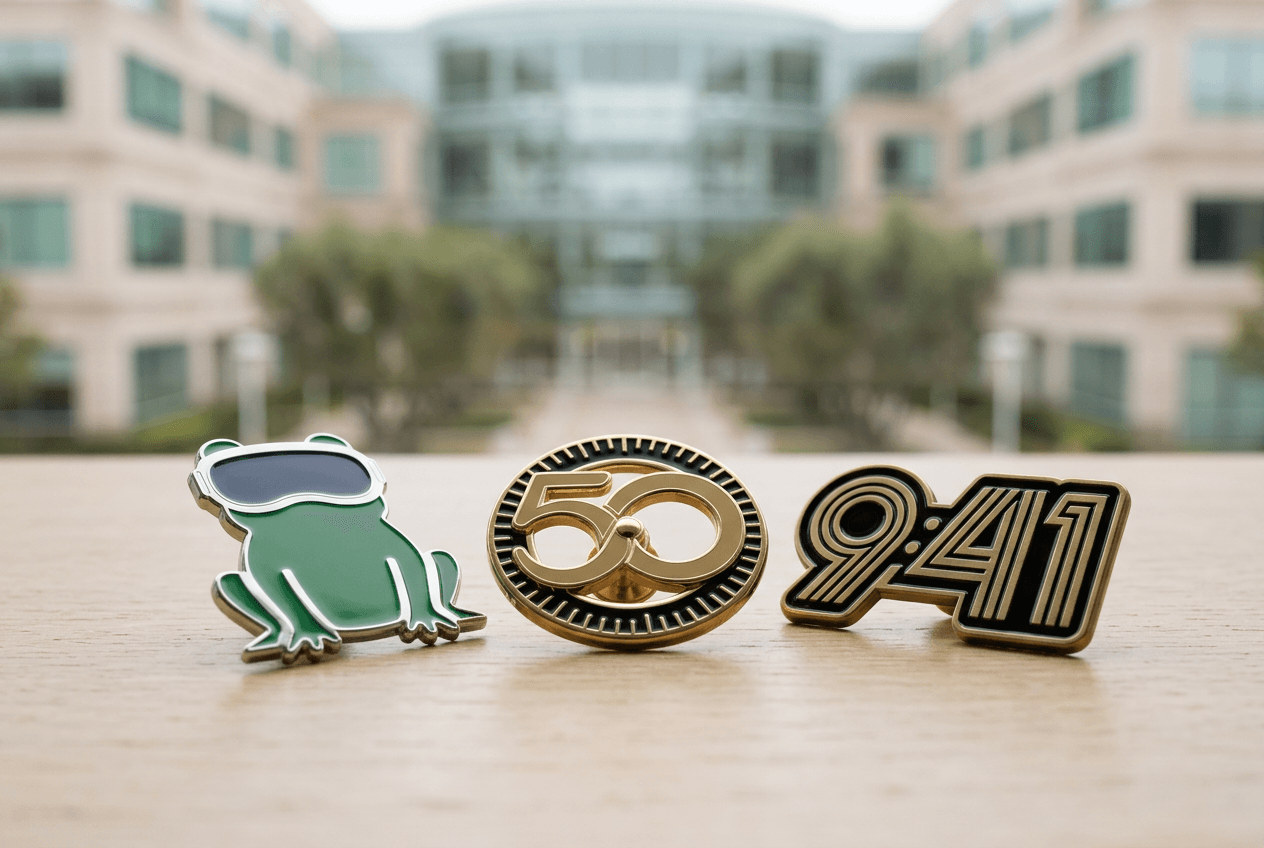
Baptiste built an entire app around that obsession, and he'll talk about it in detail in an episode of my podcast Command+P. It was obvious there had to be a pin. We spent evenings sending each other iMessages. The pin we produced is deliberately minimal. Four digits. A colon. A typeface that echoes original iOS without pastiching it. It's offered as an add-on to the campaign, which means you can add it to any tier, including the base tier with a single pin. I wanted it to be available separately, because it's as much his object as mine.
The collector tier, and the lesson I didn't see coming
Let me talk about that collector tier for a second, because it's the thing that surprised me most in this campaign. At the start: forty copies at 65 euros. The entire collection, in specific packaging, hand-signed. I'd designed it as a niche tier, almost a whim: an object for the three or four people who would really want everything, who don't want to choose, who collect on principle. I expected it to sell slowly, maybe to remain partly available until the end of the campaign.
It sold faster than all the others. By a wide margin. I had to raise the stock to 120 during the campaign so as not to frustrate people arriving after the first sellout, and even at 120 it kept moving at a pace I hadn't anticipated.
In hindsight, it should have been obvious. The Apple community is made of people who have accumulated Macs since the IIfx, who keep their iPhone boxes stacked in their mother's attic because you don't throw that away. The collector reflex isn't a side effect for us, it's a character trait. I underestimated the segment because I was reasoning as a designer ("I'm offering completeness for those who seek it") rather than as a reader of my own backers ("they all seek it, actually").
Why 40 at the start, and why didn't I blow the counter open once demand became obvious? Because I sign each copy by hand, because I want to maintain a finishing standard I couldn't guarantee at a thousand copies, and because these campaigns remain side work next to my real job. Going from 40 to 120 already required an arbitration: three times as many boxes to sign, pack, ship, disclaimer, I won't sign them... I even recruited Baptiste and Florent, my two partners in another project I'll be announcing soon.
Beyond that, it would no longer be the same object, and the tier would lose precisely what gives it its value. Forty is also, approximately, the number of people I can name in the French-speaking Apple community who, at some point, contributed to my personal growth and explain why I keep going down this path: people who, in my early days, explained a corner of this ecosystem to me. Yann, who founded AppsFire among other things and taught me to reason about business before reasoning about product. Michel, whom I affectionately call "the dinosaur" and who has seen more keynotes than most people have seen episodes of Friends. And then the people on Apple's side without whom none of this parallel ecosystem would exist: Jerome, who constantly teases us without telling us anything (he isn't allowed to, we know, we insist anyway), Shan, Mac and Martin, who always do everything they can to make sure we leave with the keys we need, David, Esther, and all the others doing silently loud work. You never hear their names in a keynote, but they're the ones who make the week possible for thousands of developers.
If you snagged one of the 120, know that you're also taking on a tacit responsibility: talking about it. These pins travel because people wear them, show them, give them away. I've never paid for ads on these campaigns. Word of mouth in the Apple community is enough, and that's precisely what makes it a healthy project, and probably what explains why a "high" tier designed for a few turned out to be what the many needed.
A word on the other pins
I won't detail them all, you can read the Kickstarter page for that. But a few quick mentions to set the scene. There's a Swift 6 pin, because the migration to strict concurrency checking marked a rupture worth commemorating. How many of us asked ourselves whether we were really going to rewrite this entire codebase? There's an Apple Intelligence pin, subtler than it looks. There's a reference to a specific iOS release note that I won't spoil here, because the people who are meant to understand will understand when they see the pin. And there are more personal homages to quiet frameworks we've all used without their ever making headlines.
What binds all these pins, beyond visual coherence, is that they are thought up by an Apple fan for Apple fans. No marketing consultant has ever told me which reference would sell better than another. The rule is simple: if I don't want to wear it on my own jacket, I don't produce it. That probably explains why some pins from the 2021 collection are still sleeping at the back of a drawer at my place. I'd given in to suggestions that were too obvious. I learned.
The WWDC ahead, and what's next
In a few weeks, I'll be in San Francisco and then Cupertino. I'll run the WWDC Run with a few brave developers early one morning. I'll host the fifth edition of the French-speaking dinner, which gathers around thirty French-speaking devs around a much-too-long table every year. I'll run an AI evening whose exact details are still being worked out, but whose idea is to bring together the people actually building with Apple Intelligence and Core ML rather than the people talking about it. And between all that, I'll hand out pins to those who backed the campaign and made the trip.
If you'll be there and want to join us for one of these moments, the best way is through dubdub.community (the app is coming very soon), the hub where I centralize RSVPs, announcements, links, and people. And even if an official WWDC ticket remains the most coveted key to the week (fingers crossed for mine, by the way), many parallel moments remain accessible to people who make the trip without a badge. That, too, is WWDC, and it's not the least interesting part.
As for the Kickstarter campaign itself, it is now closed. The pins are in production, the first copies are arriving. If you backed it, you'll know soon. If you missed it, keep an eye on 2027, or better yet, come talk about it in person in June.
Why I keep going
To finish, because I know this question will come back. Why keep doing this in 2026, when I could spend these weeks on better-paid consulting, on code I'd sign under my own name, on a thousand more rational things?
Because eighteen years after publishing my first app on the App Store, a few days after it opened, I remind you, by luck and insomnia, I still want to belong and to exist. Not one without the other. Both. To belong to a milieu, an obsession, a lineage; and to exist within it strongly enough to be recognized, cited, handed the mic. That's human, and I'm not going to pretend the light doesn't feel good when it lands on something you've built. Apple turned fifty this year, and I'll have contributed only a microscopic fraction of what it has produced. But the pins are my footprint. They're tiny objects of almost nothing that people from all over the world will clip to their lanyards in June and that might, perhaps, spark a conversation, a contact, a project, a friendship.
See you very soon, in Cupertino.