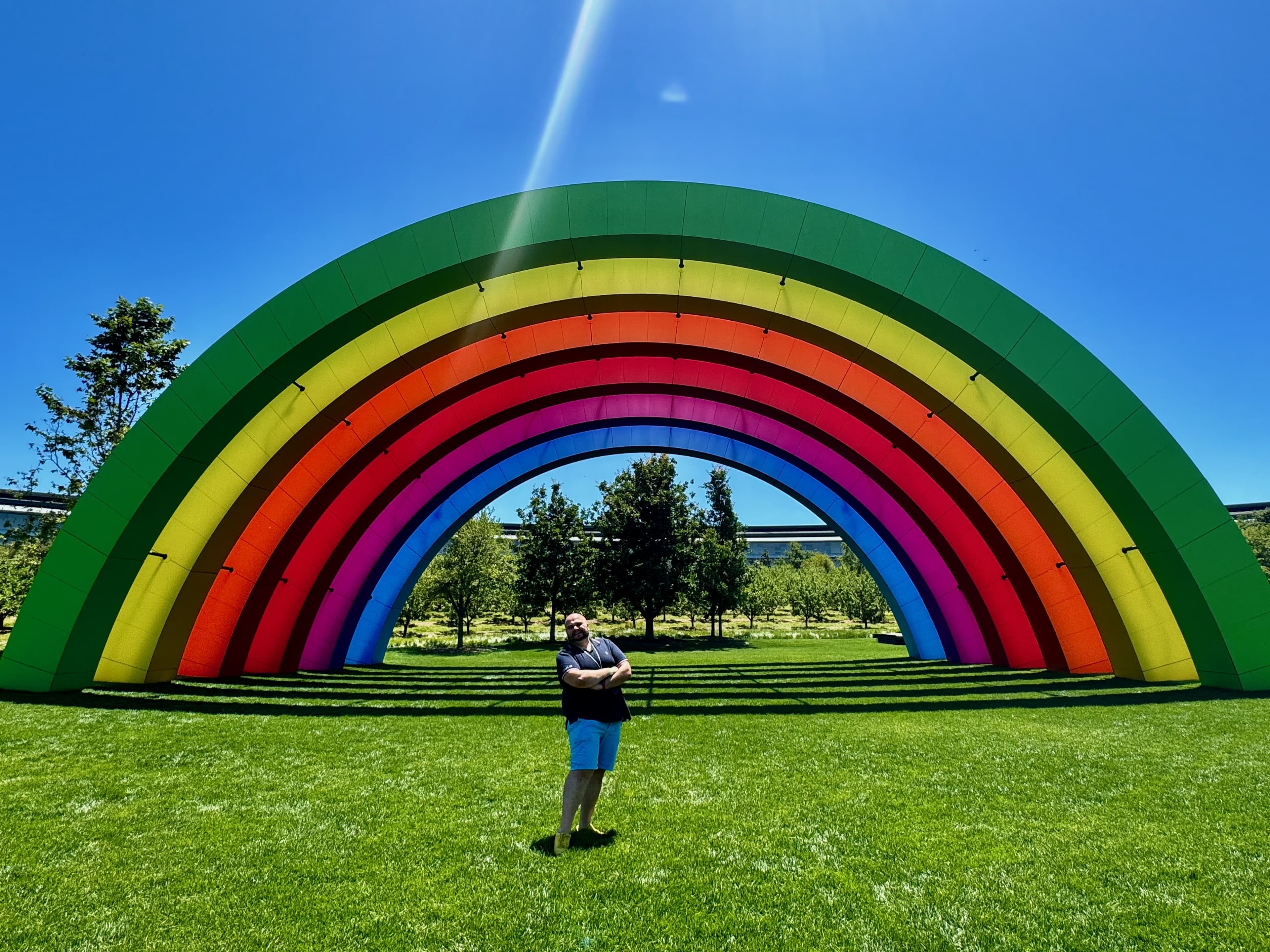
Every June, Apple brings together its global developer community for a week that reshapes the iOS and macOS ecosystem. Here's what WWDC really is — from its origins to how to get through the door — from someone who's been going since 2011.
What is WWDC, exactly?
Summer 2011. First flight to the West Coast, destination California. A WWDC ticket in my pocket (no lottery back then). And this strange feeling of having spent two months' rent to go watch slides.
I was obviously wrong about that last part.
WWDC — the Worldwide Developers Conference — or affectionately "DubDub" — is Apple's annual event for its developer community. Five days in June (three on-site today). Two keynotes, technical sessions, labs with Apple engineers. And something indefinable that makes people cross the Atlantic (and the United States) to attend, even when they could watch everything streaming from their couch.
Since 2011, I've only missed one edition — against my will. In 2015, I didn't win the lottery, so I borrowed a friend's badge (hi Erwan) to slip into 2 labs and 3 talks I cared about (shhh). That's how much skipping it wasn't really an option.
This first article is an introduction: the history of the conference, its current format, and how to access it — whether you've been an Apple developer for ten years or you're hearing about WWDC for the first time. The next two articles will go further: the side events and the community that's built up around WWDC, then the strategic angle for developers and companies.
A conference that's 36 years old
WWDC officially started in 1990, in San José (there was an Apple Independent Software Developers Conference in '83 and other DevCons before, but those predate the "WWDC" name). The context: Apple needed to talk to its Macintosh developers. There was no internet to distribute documentation. The conference was literally the only channel — technical, low-key, reserved for a few hundred people writing software for the Mac.
It stayed in San José for 14 years, then moved to San Francisco in 2003. The Moscone Center. And there, something changed in nature: Apple started using WWDC as the stage for its major software announcements. Steve Jobs' keynotes became cultural moments. The technical conference gradually became a global event.
What truly changed the nature of the conference was 2008 and the launch of the App Store. Suddenly, millions of independent developers had direct access to hundreds of millions — today billions — of customers. WWDC was no longer just a technical briefing. It had become the centerpiece of an entire economic ecosystem — with all the stakes, tensions, and opportunities that implies.

In 2017, back to San José — exactly 14 years after leaving. The reason is less romantic than it sounds: Moscone West was under renovation. But there's also an obvious geographic logic that everyone in the community had eventually articulated: San José is much, much closer to Apple's various campuses than San Francisco. Less commute for engineers. Less friction for everyone.
2020 changed the format again: the COVID-19 pandemic forced a fully online WWDC for the first time, same in 2021. Since 2022, hybrid format — an online stream open to all, and three days in-person at Apple Park for a selection of developers and students. That's the format in place for the 2026 edition, running June 8 through 12.
What happens during a WWDC week
The structure of the week is well-established, and it works.
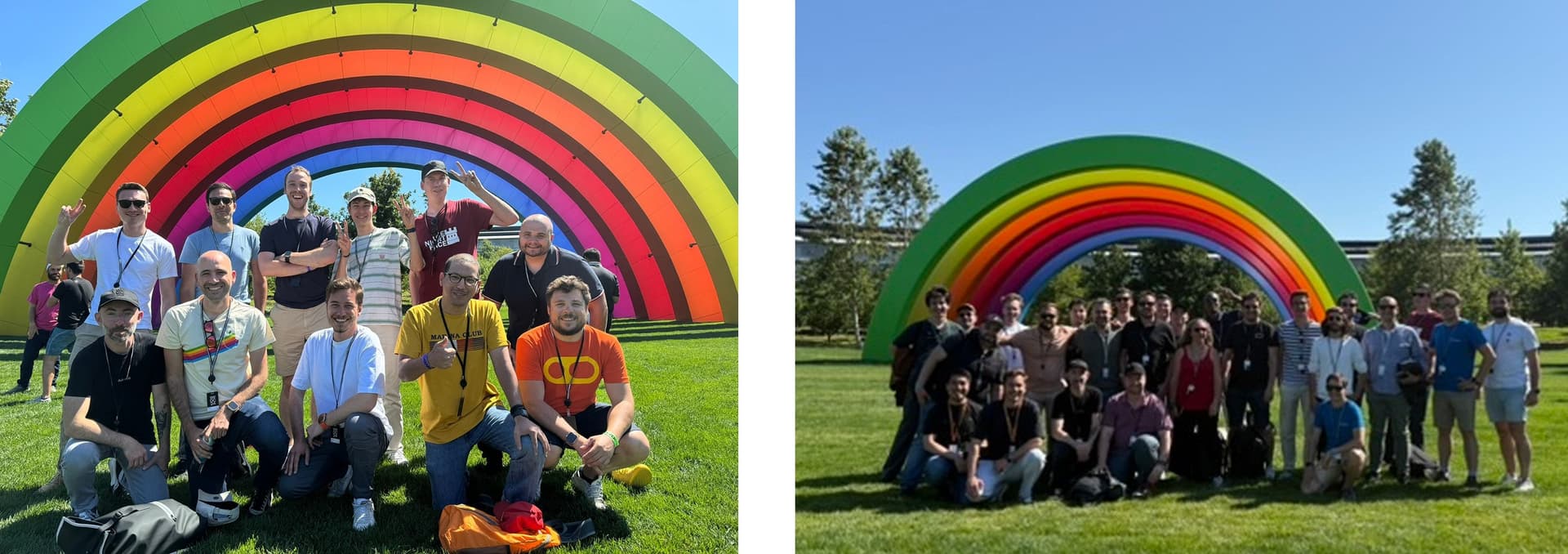
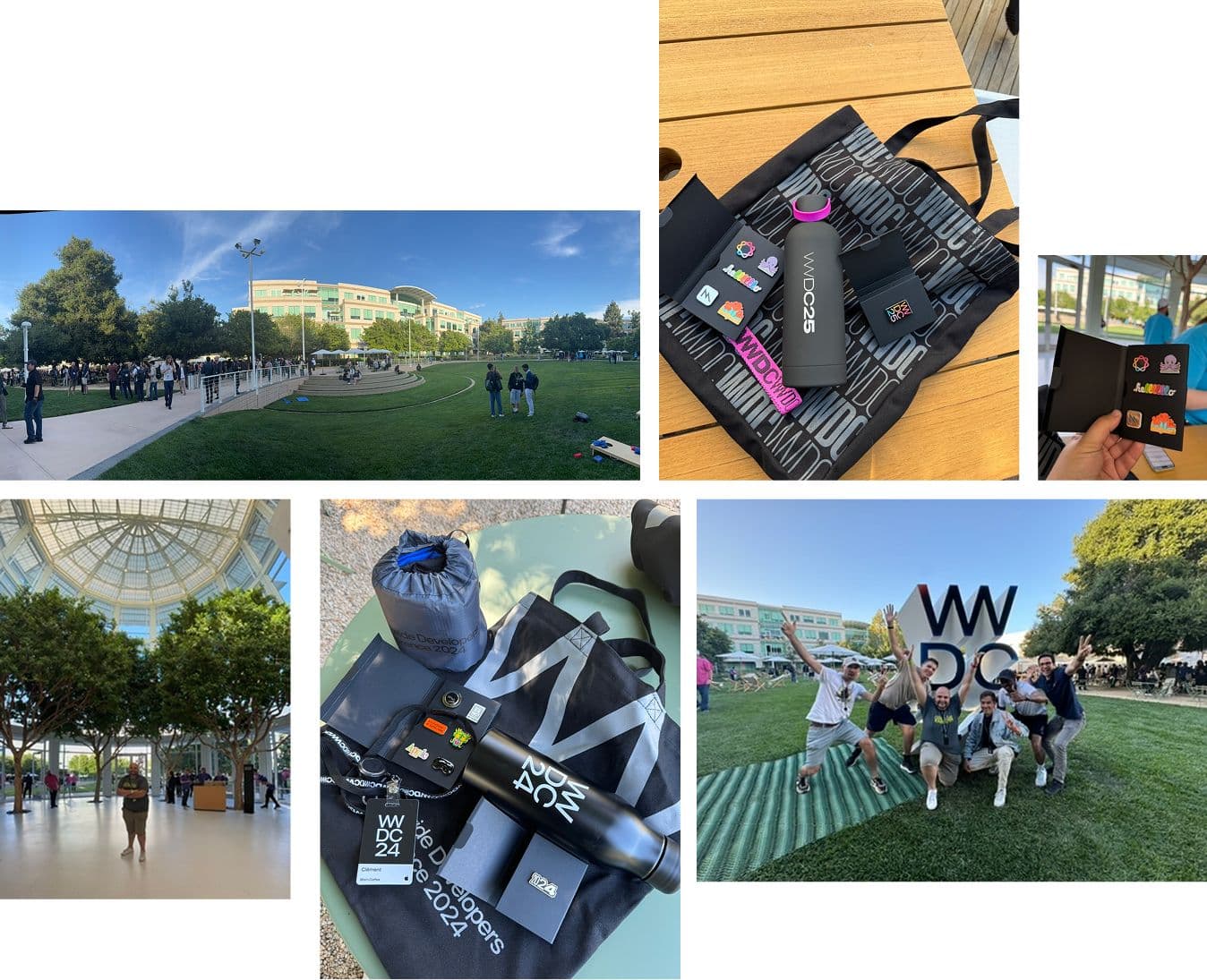
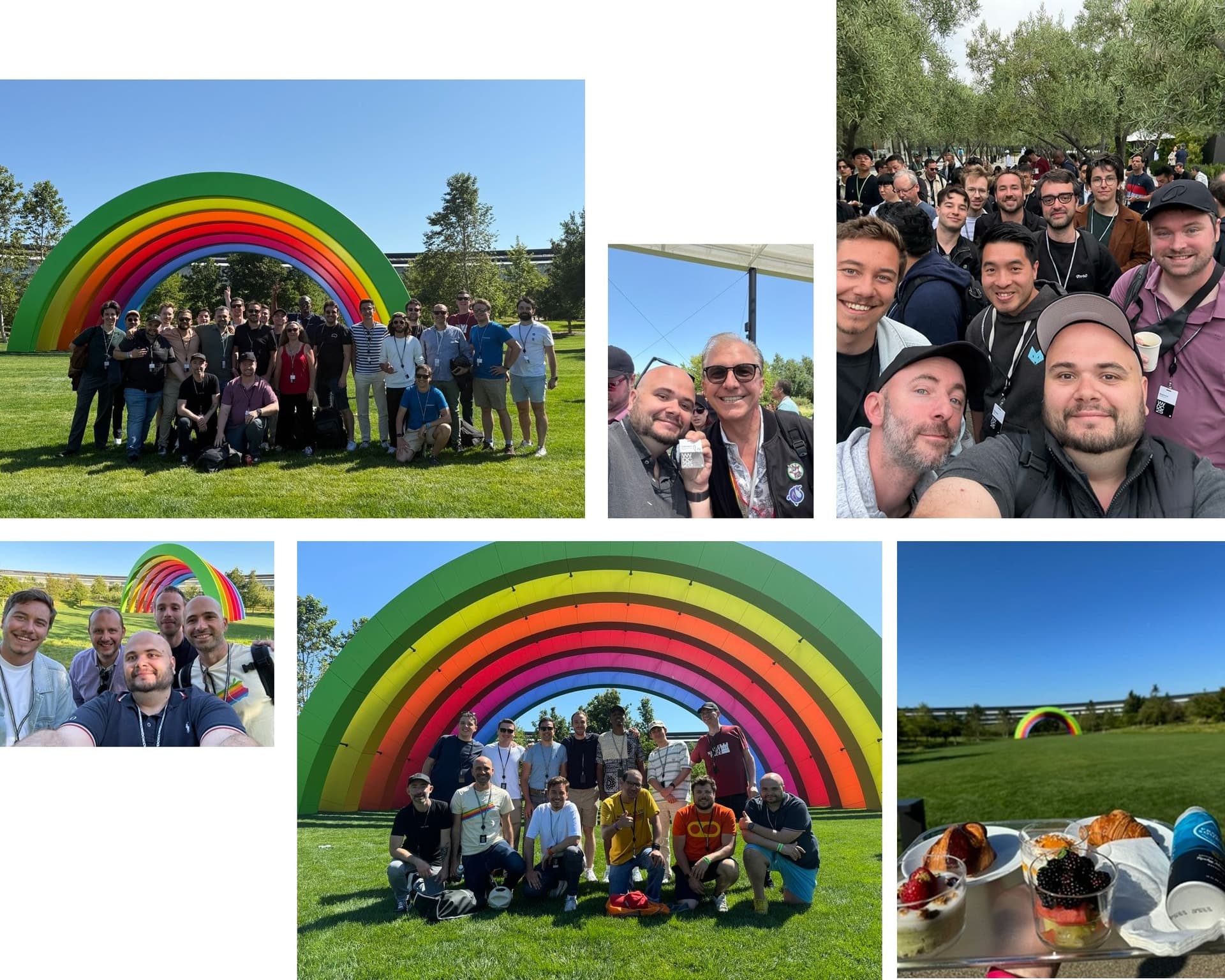
For developers selected for the in-person component, everything starts on Sunday with a mixer on the 1 Infinite Loop campus — Apple's historic former headquarters, about a twenty-minute walk from Apple Park. An outdoor afternoon where people meet for the first time, introduce themselves, compare expectations for the week. And trade pins — because yes, that's a genuine community tradition, and I say that with absolutely no conflict of interest 🤪. It seems like a casual moment, but it sets the social rhythm for the entire week.
Monday is the keynote. Two to three hours pre-recorded like a film — Tim, Craig, the VPs, the demos. Apple unveils its new operating systems: iOS, iPadOS, macOS, watchOS, tvOS, visionOS. The entire platform in one evening. For 2026, we're expecting iOS 27 and macOS 27, but the central story is Apple Intelligence: Apple made a lot of promises since WWDC 2024, around conversational Siri among other things. We should finally see what holds up.
Right after the keynote, the Platforms State of the Union. Two more technical hours, ignored by the mainstream press, and yet this is where the real substance is for us, developers. New APIs, evolving frameworks, deprecations to plan for. The real briefing of the week — not the Monday morning spectacle. After that, the labs — 30-minute sessions face-to-face with specialized Apple engineers, in-person for on-site attendees, video calls for everyone else. You show up with a specific bug, an API question, a crash you can't reproduce. And you have someone in front of you who may have written the framework you're using. That's not trivial.
Tuesday through Friday, Apple publishes dozens of video sessions — sometimes over a hundred. 20 to 40-minute tutorials, delivered by the engineers who actually wrote the code, freely available in replay for years. It's a colossal educational resource, often underestimated because it doesn't generate buzz.
In 2015, I slipped into two or three labs on the borrowed badge. Technically irregular, absolutely forbidden, and professionally one of the best decisions I made that year.
Online or in-person: what's changed since 2020
Before 2020, attending WWDC in person cost $1,599 — and even then, you had to win the lottery (since 2014) for the right to pay. To give you a sense of the scale: in 2013, all spots were gone in 73 seconds. From 2011 to 2019, I spent the equivalent in conference tickets. It never seemed unreasonable given what I was coming back with, but it was objectively very selective access.
Since the pandemic, all sessions are free and online for any developer enrolled in the Apple Developer Program, from any country. It's a radical democratization of content — the informational barrier has essentially disappeared. Someone learning Swift in Lille, Montreal, Niamey, or Tokyo has access to the same resources as an engineer in San Francisco.
But there's something online can't replicate. Since 2022, Apple invites a selection of developers and students for three days in-person at Apple Park. In 2026, applications were open until March 30 — today — with results on April 2.
The lucky ones have a three-day program. Officially, that's it. Unofficially, quite a lot more happens around it — but that's what the next article is about.
The Swift Student Challenge
Alongside the main conference, Apple runs the Swift Student Challenge — an international competition for student developers. The concept: build an original Swift Playgrounds app. Winners get official recognition. Distinguished Winners — a small handful of laureates — are invited to Cupertino for a multi-day experience. For many of them, it's the first serious recognition. And often the starting point of a career in the Apple ecosystem.
How to follow WWDC 2026, practically speaking
Whether you're in Cupertino or in Europe, the resources are available at several levels.
For free, without doing anything special: all video sessions will be available on developer.apple.com, the Apple Developer app, YouTube, and the Apple TV app. Subtitled, well-indexed, available in replay for years. It's a goldmine — most developers watch only a fraction of what gets published each year.
With the Apple Developer Program ($99/year): access to developer betas from the evening of the keynote — iOS 27, macOS 27, all of them. This is where it gets real. You install the beta, you compile your app, and you immediately find out what breaks, what improves, what you need to adapt before September. No Apple Developer membership, no early access — it's that simple.
For remote labs: Apple offers 30-minute video slots by appointment. Spots go fast, often the same morning when registration opens. From Europe, that means some early mornings. Worth it — especially if you have a specific problem to work through during the week.
For in-person: apply via the Apple Developer app or website, random lottery, no guarantees. Deadline: March 30. If you're an Apple developer and haven't done it yet, now is the time.
What WWDC is not
An important point, because the mainstream press gets this wrong consistently: WWDC is not a hardware conference.
Apple can occasionally slip in some hardware — the Apple Vision Pro was revealed there in 2023, and some years see unexpected Mac announcements. But that's the exception. It's not an iPhone event. Not an iPad event. WWDC is about software — frameworks, APIs, Swift, SwiftUI, Xcode, on-device AI. The daily life of the Apple developer.
The real WWDC doesn't happen during Monday's keynote. It happens in the PSotU, in a Tuesday afternoon session on the new SwiftData APIs. In a lab where an engineer explains why your SwiftUI implementation is underperforming. In a hallway where you run into the person who moved the needle on the bug you filed on Feedback Assistant six months ago. Journalists who cover this like a product event consistently miss the point.
Why 2026 specifically
This edition looks like a turning point. iOS 27 should be the catch-up edition: Siri genuinely conversational, better and more mature Foundation Models, deep AI integration in developer tools. The kind of shift that concretely redefines what "developing for Apple" means — not just for consumer apps, but for tools, workflows, SDKs.
For an iOS or macOS developer, missing this WWDC could mean missing a paradigm shift. The kind of week you're still talking about five years later. In 2011, I lived through the post-iCloud WWDC, right before the App Store really exploded. I didn't grasp the scale of what was happening at the time. I'd rather not make that mistake again.
What's next
The next article is about what happens around the official WWDC — the side events, the community, the dinners, the encounters that change a trajectory. And why some of the most important things I've experienced in San Francisco or Cupertino never happened inside an Apple conference room.
Following Apple news and iOS development? Subscribe to my newsletter — I've been covering WWDC since 2011, from the perspective of a premium consultant and agency. And if you want to explore the strategic value of the conference for your team or company, feel free to reach out.